

Pinky Paaji had just opened a dhaba in Leh, 3,500 metres up. Twenty hungry bikers ordered his famous rajma, and their leader gave him half an hour, or the review would say "cold dhaba, raw rajma".
But after three hours of boiling, the beans were still as hard as stones. Paaji turned the gas to full. The water boiled even harder, and the rajma stayed exactly the same.
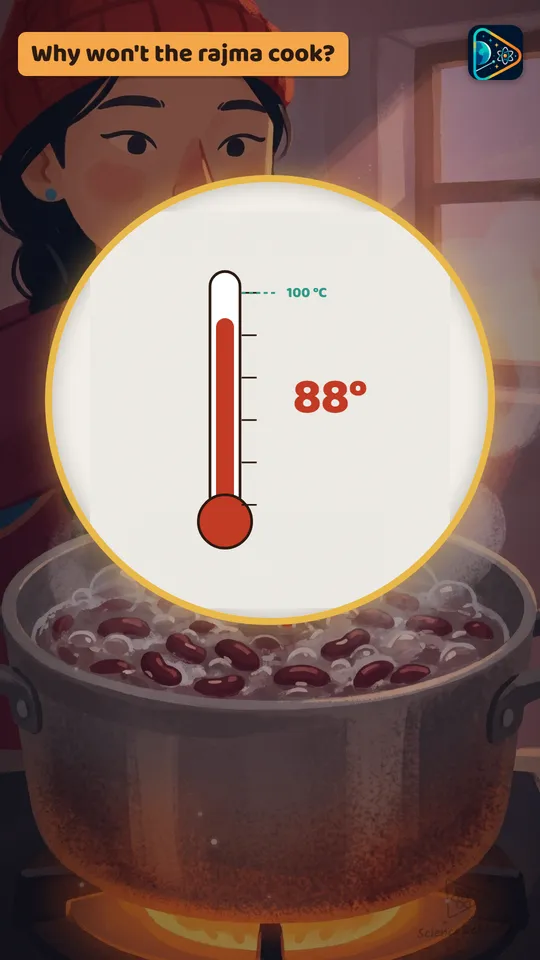
Then Tsering, who sold tea next door and studied for JEE at night, put a thermometer in the pot. The water was boiling, but it was only at 88 °C.
1. When does water boil?
Water boils when bubbles of steam can form inside it. That happens when the vapour pressure of the water (the push of its own steam) becomes equal to the pressure of the air pressing down on its surface.
boiling: vapour pressure = outside pressure
the boiling point depends on the pressure above the water
At sea level, air pressure is 1 atmosphere, and water's vapour pressure reaches 1 atm at 100 °C. That is why "water boils at 100 °C" is only true at sea level.
2. Why the boiling point drops in the mountains
Higher up there is less air above you, so the air pressure is lower. In Leh it is only about 0.65 atm, about two-thirds of sea level. The water's vapour pressure reaches that lower value sooner, at a lower temperature.
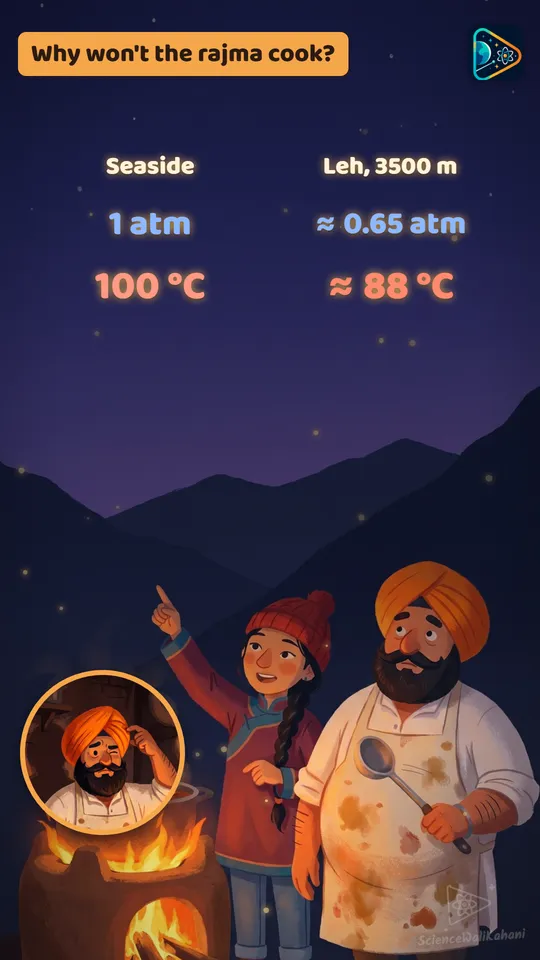
A handy rule of thumb: the boiling point drops by about 1 °C for every 300 m you climb.
3500 ÷ 300 ≈ 12 → 100 − 12 = 88 °C
the same 88 °C that Tsering measured
| Place | Height | Air pressure | Water boils at |
|---|---|---|---|
| Mumbai | sea level | 1 atm | 100 °C |
| Shimla | 2,200 m | ≈ 0.77 atm | ≈ 93 °C |
| Leh | 3,500 m | ≈ 0.65 atm | ≈ 88 °C |
| Everest summit | 8,849 m | ≈ 0.33 atm | ≈ 70 °C |
3. Why a bigger flame doesn't help
Once water is boiling, its temperature stops rising. Every extra joule from a bigger flame goes into turning liquid water into steam (the latent heat of vaporisation, about 2,260 J for each gram), not into raising the temperature.
So Paaji's rajma sat at 88 °C no matter how much gas he burned, and at 88 °C the beans soften very slowly.
4. The pressure cooker: raise the pressure, raise the boiling point
A pressure cooker traps the steam. The whistle weight only lets steam out once the pressure inside is about 1 atm above the outside air.
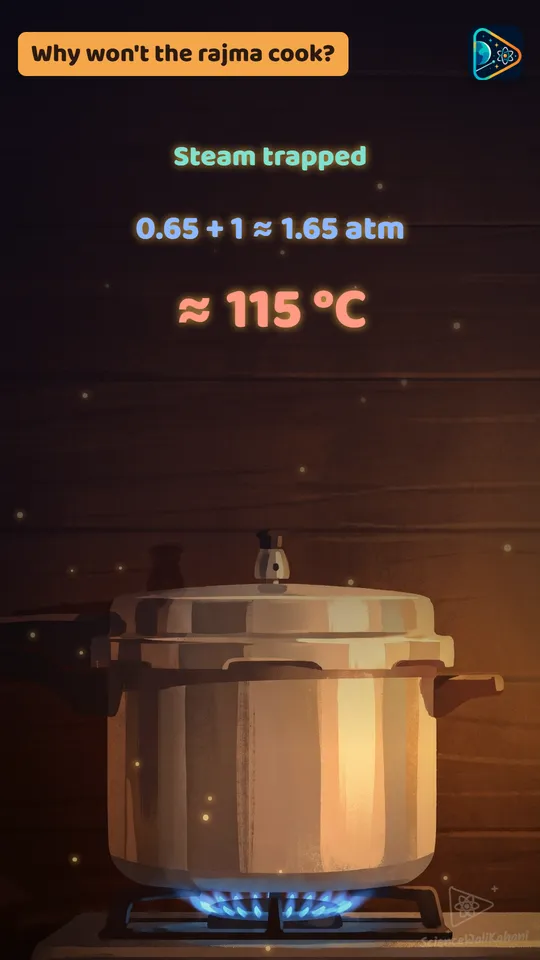
0.65 atm + 1 atm ≈ 1.65 atm → boils at ≈ 115 °C
at sea level the same cooker reaches about 2 atm and 120 °C
How much faster? The 10 °C rule
Cooking is chemistry: starch and proteins break down through reactions. A common rule of thumb (NCERT Class 12, Chemical Kinetics) is that the rate roughly doubles for every 10 °C rise.
115 − 88 ≈ 27 °C ≈ 2.7 steps of 10 °C → 2^2.7 ≈ 6.5× faster
3 hours ÷ 6.5 ≈ 28 minutes
That's why the cooker whistled in about 25 minutes, with rajma "as soft as butter".
5. Practice questions
Class 9
Water boils at 100 °C in Chennai but at a lower temperature in Leh. The main reason is: (a) less oxygen (b) lower air pressure (c) colder weather (d) harder water
Show answer
**(b) lower air pressure.** Boiling happens when the vapour pressure equals the outside pressure, and that is reached at a lower temperature when the outside pressure is lower.Class 9–11
While water is boiling on a stove, you double the flame. What happens to the water's temperature?
Show answer
It stays the same (at its boiling point). The extra heat goes into latent heat, converting more water into steam, so it only boils away faster.Class 11
Using "about 1 °C lower per 300 m", estimate the boiling point at a hill station 2,400 m high.
Show answer
2,400 ÷ 300 = 8, so about **100 − 8 = 92 °C**.NEET / JEE
A reaction's rate doubles for every 10 °C rise. By what factor does it speed up when the temperature goes from 70 °C to 100 °C?
Show answer
30 °C = 3 steps, so 2³ = **8 times** faster.NEET / JEE
Why does a pressure cooker cook food faster?
Show answer
It raises the pressure above the water, which raises the boiling point (to about 120 °C at sea level). The higher temperature makes the cooking reactions much faster.JEE
The latent heat of vaporisation of water is about 2,260 J/g. How much heat is needed to boil away 500 g of water that is already at its boiling point?
Show answer
Q = mL = 500 × 2,260 = **1,130,000 J ≈ 1.13 MJ**. Notice that none of it raises the temperature.6. The quiz from the video
At the top of Mount Everest, at what temperature does water boil?
About 70 °C. At 8,849 m the air pressure is only about a third of sea level, so water's vapour pressure matches it at roughly 70 °C. You could put your finger in "boiling" water there for a moment, and you could never cook dal without a pressure cooker.
Remember this
- Water boils when vapour pressure = outside pressure.
- Lower pressure means a lower boiling point: about −1 °C per 300 m; Leh ≈ 88 °C, Everest ≈ 70 °C.
- While boiling, extra heat becomes latent heat; the temperature doesn't rise.
- A pressure cooker raises the pressure, so it raises the boiling point (≈ 120 °C at sea level).
- Rule of thumb: the reaction rate roughly doubles per 10 °C.
Syllabus: NCERT Class 9 Science, Matter in Our Surroundings; NCERT Class 11 Physics, Thermal Properties of Matter; NCERT Class 12 Chemistry, Chemical Kinetics.