

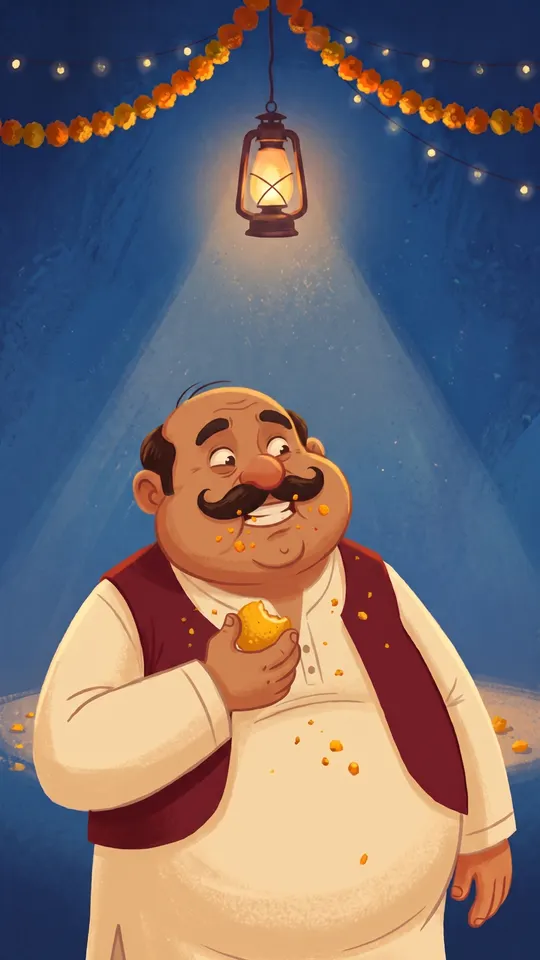
The night before the wedding, Ramesh Halwai's fifty kilos of laddoos vanished. The wedding party was arriving the next morning, and there were three suspects: Motu Chacha ("I only tasted twenty-five!"), sleepy Pappu, and the dramatic Band-master ji.
Tanu, who was preparing for NEET, found the only real clue: a half-eaten laddoo with teeth marks. "Everyone has teeth," said the halwai. "Yes," said Tanu, "but everyone's DNA is different."
Here is how she solved it, and the biology behind every step.
1. Where does the DNA come from?
When you bite into food, your saliva leaves some cheek cells (buccal epithelial cells) on it. Every one of those cells has a nucleus, and the nucleus holds your DNA.
2. Why is everyone's DNA different?
About 99.9% of the DNA of any two people is identical. All the difference lies in the remaining 0.1%, and that is still millions of base pairs.
Some of that difference is in repetitive DNA: short sequences repeated again and again, side by side. The number of repeats at these places differs from person to person. These are called VNTRs (Variable Number of Tandem Repeats); forensic labs today mostly use shorter ones called STRs.
99.9% same + 0.1% different = a unique pattern
repeat counts differ between people
Because you inherit one copy of each region from each parent, the pattern also works for paternity tests.
3. PCR: a photocopy machine for DNA
One laddoo carries very little DNA, far too little to test. PCR (Polymerase Chain Reaction) fixes that by copying one chosen piece of DNA over and over. Each cycle has three steps:
- Denaturation (about 95 °C): heat separates the two DNA strands.
- Annealing (about 50–60 °C): short primers bind on either side of the region to be copied.
- Extension (72 °C): Taq polymerase builds the new strands.
Taq polymerase comes from Thermus aquaticus, a bacterium that lives in hot springs, so the enzyme survives the 95 °C step in every cycle.
The number: why 30 cycles is enough
Each cycle doubles the copies, so after n cycles:
copies = N₀ × 2ⁿ
N₀ = copies at the start
From a single copy, 30 cycles give:
2³⁰ = 1,073,741,824
more than a billion copies
"I never made that many laddoos in my whole life!" said the halwai. In a real lab, efficiency is a little below 100%, so the actual number is somewhat lower, but still enormous.
4. Gel electrophoresis: reading the barcode
The copied DNA is cut into pieces and placed in wells at one end of a jelly-like agarose gel. When an electric current is switched on:
- DNA has negatively charged phosphate groups, so it moves towards the positive electrode (anode).
- The gel acts like a sieve: small pieces travel farther, and large pieces stay nearer the wells.
The result is a set of bands, a pattern that looks like a barcode, and every person's barcode is different.
That was the twist: two different barcodes. Laddoo 1 matched Pappu ("I was sleepwalking!") and laddoo 2 matched Motu Chacha ("I was only checking the quality!").

The textbook method (NCERT)
The classic method developed by Alec Jeffreys uses a VNTR probe: isolate DNA → cut it with restriction enzymes → separate by electrophoresis → transfer to a nylon membrane (Southern blotting) → hybridise with a labelled VNTR probe → detect by autoradiography. Modern labs add PCR so that even a tiny sample is enough.
5. Practice questions
Try each one before you open the answer.
Class 12
Why can't a sample of only mature red blood cells be used for DNA fingerprinting?
Show answer
Mature human RBCs have **no nucleus**, so they carry no nuclear DNA. White blood cells are used instead.NEET
In agarose gel electrophoresis, DNA fragments move towards the: (a) cathode (b) anode (c) centre of the gel (d) they do not move
Show answer
**(b) anode.** The phosphate groups make DNA negatively charged, so it moves towards the positive electrode.NEET
Why is Taq polymerase used in PCR instead of an ordinary DNA polymerase?
Show answer
It comes from the heat-loving bacterium *Thermus aquaticus* and is **thermostable**: it survives the 95 °C denaturation step in every cycle, so it doesn't need to be added again.NEET / JEE
A sample starts with 5 copies of a DNA region. Assuming perfect doubling, how many copies are there after 10 PCR cycles?
Show answer
5 × 2¹⁰ = 5 × 1,024 = **5,120 copies**.NEET / JEE
What is the minimum number of cycles needed to get at least one million copies from a single DNA molecule?
Show answer
2¹⁹ = 524,288 (not enough) and 2²⁰ = 1,048,576. So **20 cycles**.NEET
DNA fingerprinting is based on differences in: (a) genes for enzymes (b) repetitive DNA such as VNTRs (c) ribosomal RNA (d) the number of chromosomes
Show answer
**(b)** The number of repeats in repetitive DNA (VNTRs/STRs) differs between individuals.6. The quiz from the video
If Pappu had an identical twin, could this DNA test tell them apart?
No. Identical twins come from one fertilised egg, so their DNA is essentially the same, and a standard DNA fingerprint gives the same barcode for both. Police would need other evidence, such as ordinary fingerprints, which do differ between identical twins.
Remember this
- Source: any cell with a nucleus (saliva, skin, WBCs, hair root). Mature RBCs have no nucleus.
- Basis: 99.9% of DNA is the same; repeat numbers in VNTRs/STRs make each pattern unique.
- PCR: denature (about 95 °C) → anneal (about 55 °C) → extend (72 °C, Taq polymerase). Copies = N₀ × 2ⁿ; 30 cycles ≈ 10⁹.
- Gel electrophoresis: DNA is negative, so it moves to the anode; smaller pieces travel farther.
- Identical twins have the same DNA fingerprint.
Syllabus: NCERT Class 12 Biology, Molecular Basis of Inheritance (DNA fingerprinting) and Biotechnology: Principles and Processes (PCR, gel electrophoresis).