

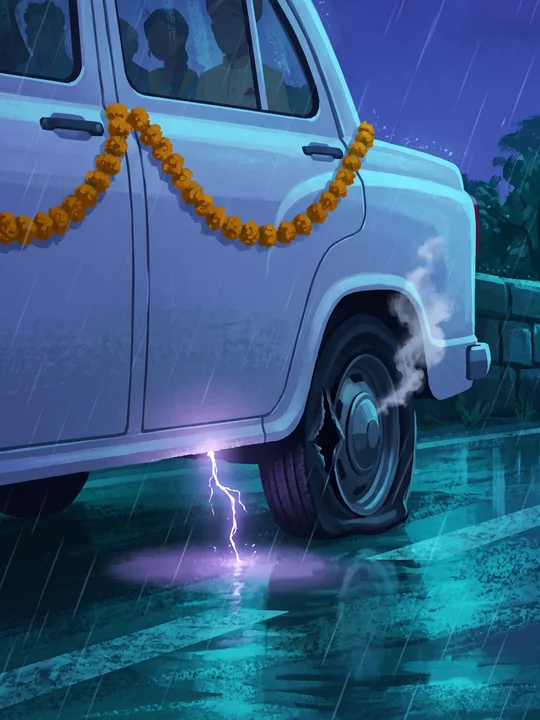
A monsoon storm on the Mohand ghat, the road from Delhi to Dehradun through the Shivalik hills. The groom's taxi, decked with marigolds, is stuck on a bend with the wedding still far ahead. Driver Bablu bhaiya puts both feet up on the dashboard and grins: "Relax, Tauji! Rubber tyres! Current can't climb!"
Tauji is not relaxed. "Iron car! Everyone out, go under that tree!" He is already reaching for the door when the groom's younger sister Tanu, in Class 12, pulls it shut: "Nobody goes out! And nobody touch the metal."
Then it happens. Crack. The lightning hits the roof of the taxi itself. The radio dies, a rear tyre bursts with a bang, and all four people inside are completely fine. Bablu is ready to thank his tyres. Tanu is not.

1. The rubber was never the shield
Bablu's idea sounds logical: rubber is an insulator, the tyres sit between the car and the road, so the current "can't climb". It fails for a simple reason. The lightning has just crossed several kilometres of air, and air is also an excellent insulator. A spark that jumps kilometres of air will not be stopped by a few centimetres of rubber. The US National Weather Service says it plainly: the rubber tyres do not protect you from lightning.

So what did protect them? Not the rubber, but the metal: the roof, the doors, the whole body of the car around them.
2. The current runs over the outer metal skin
A typical lightning flash carries about 30,000 amperes. When it hit the roof, that current did not pour into the cabin. It ran over the car's outer metal skin, down the sides to the underbody, and then jumped from under the car to the wet road. On the way, its heat burst a rear tyre, which is why the "hero" tyre ended up as the first casualty. The NWS notes exactly this: a strike passes through the outer shell to the ground, and damaged electrics and destroyed tyres are common.
This is also why Tanu's second rule matters: don't touch the metal. The metal body is the current's road. Sit inside it and you are safe; put your hand on the door frame and you become part of that road.
3. Why does the charge go to the outside?
The current runs on the outside because of how charges behave on a conductor. Like charges repel. In a metal, charges are free to move, so when extra charge arrives, every bit of it pushes every other bit away. They keep moving until they are as far apart as they can get, and in a solid piece of metal that means onto the outer surface.
4. No push inside: the electric field is zero
The electric field is the push a charge would feel at a point. Inside the closed metal body, all the pushes from the charges on the skin cancel out exactly: no push inside means no electric field inside. Nothing drives a current through the four people sitting there.
You can see why with Gauss's law: draw any closed surface inside the metal shell. It encloses no charge (all the charge is on the outside), so the total electric flux through it is zero, and for a closed shell this means the field inside is zero everywhere.
∮ E · dA = q_enclosed / ε₀ ; inside the shell q_enclosed = 0 → E = 0
the field inside a closed conducting shell is zero, however much charge sits on its outside
This effect is called electrostatic shielding, and a closed metal box that does it is often called a Faraday cage. It is why sensitive instruments are kept in metal boxes, and why an aeroplane struck by lightning keeps flying with its passengers unhurt.

One careful note: lightning is a very fast, changing current, so the exact "E = 0" is the steady-state (electrostatic) ideal. In the real car the result is the same in practice: the current stays on the outer metal, and nothing pushes it through the people inside.
5. Previous-year question, solved
NEET 2019
A hollow metal sphere of radius R is uniformly charged. The electric field due to the sphere at a distance r from the centre:
- zero as r increases for r < R, decreases as r increases for r > R
- zero as r increases for r < R, increases as r increases for r > R
- decreases as r increases for r < R and for r > R
- increases as r increases for r < R and for r > R
Show answer
"Zero as r increases for r < R, decreases as r increases for r > R".
- All the charge q sits on the outer surface of the metal sphere (section 3).
- Inside (r < R): a Gauss surface of radius r encloses no charge, so E = 0, at every point inside, not only at the centre.
- Outside (r > R): the Gauss surface encloses all of q, so E = q / (4πε₀r²): the sphere acts like a point charge at its centre, and E falls as 1/r².
- At r = R the field jumps from 0 to its largest value, q / (4πε₀R²).
The trap: "the field must grow as you go towards the charge" makes students pick a field that rises inside. Inside the shell there is no charge to push you, so there is no field at all.
(The option letter differs between paper versions: option D on SATHEE, option A on ExamSIDE. Match the answer by its wording, not its letter.)
6. Practice questions
Class 12
A charge of +5 μC is placed on a hollow metal sphere of radius 10 cm. What is the electric field (a) at its centre, (b) at 5 cm from the centre, (c) at 20 cm from the centre? (1 / 4πε₀ = 9 × 10⁹ N m² C⁻²)
Show answer
(a) 0, (b) 0, (c) 1.125 × 10⁶ N/C. Points (a) and (b) are inside the shell, where no charge is enclosed, so E = 0. At 20 cm: E = 9 × 10⁹ × 5 × 10⁻⁶ ÷ (0.2)² = 45 × 10³ ÷ 0.04 = 1.125 × 10⁶ N/C, pointing away from the centre.
JEE pattern
A solid metal sphere and a hollow metal sphere of the same radius are given equal charges. Compare the electric field inside them, and the field at a point outside, at the same distance from their centres.
Show answer
Exactly the same. In both, all the extra charge moves to the outer surface, so the field is zero everywhere inside and q / (4πε₀r²) outside. A conductor does not care whether its middle is solid metal or empty space.
NEET pattern
Why is it safer to stay inside a hard-top car than to stand under a tree during a thunderstorm?
Show answer
The car's closed metal body carries the current over its outside and keeps the field inside at zero (electrostatic shielding). A lone tall tree is a likely strike point, and the current can jump from the trunk to a person standing next to it. The rubber tyres play no part in the car's safety.
JEE pattern
A point charge +q is placed at the centre of a neutral, hollow metal sphere (inner radius a, outer radius b). What charges appear on the inner and outer surfaces?
Show answer
−q on the inner surface, +q on the outer surface. The field inside the metal itself must be zero, so a Gauss surface drawn inside the metal must enclose zero net charge: the inner surface carries −q. The sphere is neutral overall, so +q appears on the outer surface. Shielding works from outside to inside: a charge outside a closed shell cannot create a field inside it; a charge you place inside still has its own field.
KCET pattern
The electric potential inside a charged hollow metal sphere of radius R carrying charge q is: (1) zero (2) q / (4πε₀R), the same at every point inside (3) increasing towards the centre (4) decreasing towards the centre
Show answer
(2) q / (4πε₀R), the same everywhere inside. E = 0 inside means no work is done moving a charge there, so the potential does not change: it stays equal to its value at the surface. A very common trap: E = 0 does not mean V = 0.
Class 12
Bablu says: "The tyres are rubber, so the current can't reach us." Give two reasons why he is wrong.
Show answer
(1) The lightning has already crossed kilometres of air, which is also an insulator; a few centimetres of rubber cannot stop it. (2) The current did not need the tyres at all: it ran over the outer metal skin and jumped from the underbody to the wet road. What protects the people is the closed metal body (charge on the outside, E = 0 inside), not the rubber.
7. The quiz from the video
A charged hollow metal ball. Is the electric field at its centre zero or strong?
A, zero. Like charges push each other apart, so all the charge sits on the ball's outer surface. Inside the closed metal shell nothing pushes: the field at the centre, and everywhere inside, is zero. It is the same reason the four people in the taxi were safe.
Remember this
- Rubber tyres do not protect you from lightning: it has just crossed kilometres of air.
- The current runs over the car's outer metal skin and jumps to the ground; don't touch the metal.
- Like charges repel, so extra charge on a conductor sits on its outer surface.
- Inside a closed conductor or a charged hollow sphere, E = 0 everywhere (Gauss: no charge enclosed).
- Outside a charged sphere, E = q / (4πε₀r²), as if all the charge were at the centre.
- E = 0 inside does not mean V = 0: the potential inside equals the surface value.
- Safe: hard-top metal car, windows up, don't touch metal parts. Not safe: convertibles, two-wheelers, lone trees.
Another physics story: small bulb, big shock: why a 25 W bulb outshines a 100 W bulb in series.
Syllabus: NCERT Class 12 Physics, Chapter 1 Electric Charges and Fields (Gauss's law, field of a uniformly charged thin spherical shell) and Chapter 2 Electrostatic Potential and Capacitance (electrostatics of conductors, electrostatic shielding). JEE Main and NEET unit "Electrostatics"; 2nd PUC Physics for KCET.
Sources
- NCERT Class 12 Physics: Electric Charges and Fields (Gauss's law, field of a spherical shell) and Electrostatic Potential and Capacitance (electrostatics of conductors, electrostatic shielding)
- US National Weather Service, Lightning and Cars
- US National Weather Service, How powerful is lightning?
- SATHEE (IIT Kanpur), NEET 2019 Physics Q13
- ExamSIDE, NEET 2019 hollow metal sphere question
Keep reading
 Who makes the antibodies? Active vs passive immunity and the yellow first milkGranny Bebe wanted to throw away the thick yellow first milk, and Pinky Aunty wanted every vaccine "for instant protection". Learn the Y-shaped antibody, active vs passive immunity, why colostrum (IgA) works from day one, why a vaccine needs about two weeks, and solve the NEET 2023 and NEET 2020 questions.
 The baraat arrived, the lights died: why the fuse kept blowingChhotu wired every light in parallel, yet at 8:30 the whole pandal went dark. Learn I = P/V, why currents add up in the main wire, P = I²R heating, why a fuse must never be replaced by copper, and solve the NCERT 2 kW oven question.
 Small bulb, big shock: why a 25 W bulb outshines a 100 W bulb in seriesAt a wedding in Meerut, Chhotu wired a 25 W and a 100 W bulb on one wire and the small one blazed. Learn why, with P = I²R, R = V²/P, the 4 W vs 16 W calculation and a solved NEET 2024 question.