

After the bulb fiasco on the mehndi night, Fufaji still gave tent-man Chhotu the lighting for Pinky didi's main wedding night, with one condition: the baraat arrives at exactly 9 PM, and if even one bulb goes out then, there is no payment.
This time Chhotu had learned his lesson. He connected every bulb, every light string and every focus light in parallel, straight across the main line, so each one got the full 220 V. At 7 PM the whole pandal glowed like gold.
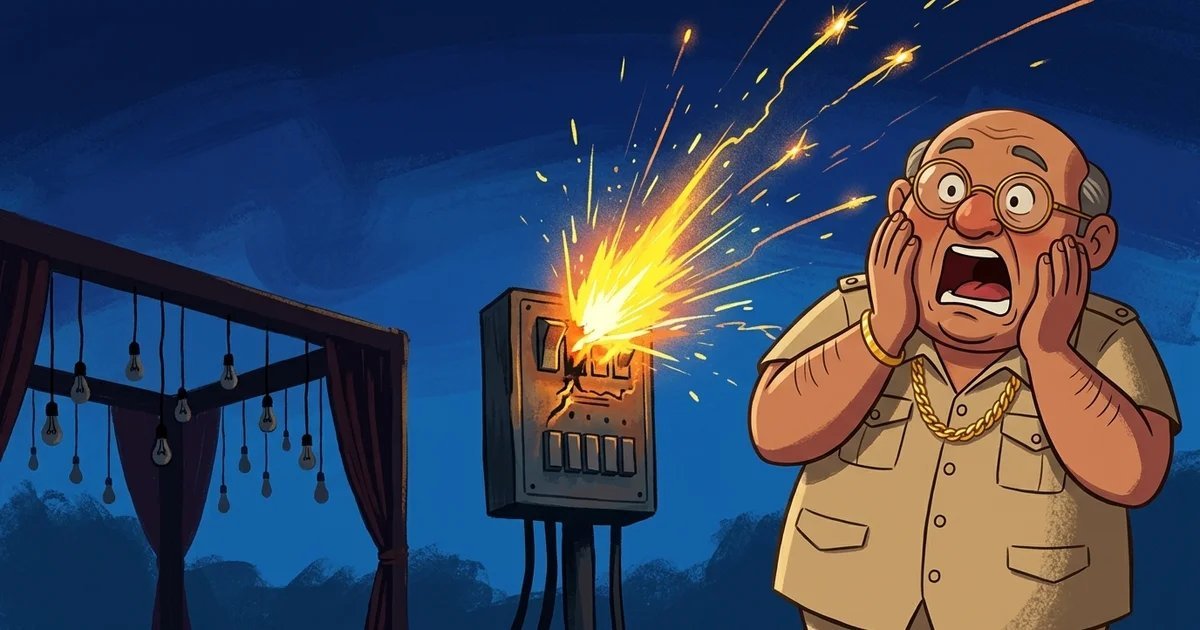
Then evening came and everyone wanted power. The halwai plugged in two 2000 W heaters for hot water and sugar syrup, and DJ uncle his 3000 W sound system. At 8:30, half an hour before the baraat, there was a loud click and the whole pandal went dark.
1. Parallel gives full voltage, not unlimited current
Chhotu was right about one thing: in parallel every appliance sits directly across the mains, so each one gets the full 220 V and works at its rated power. His mistake was the next sentence: "now plug in as many things as you like."
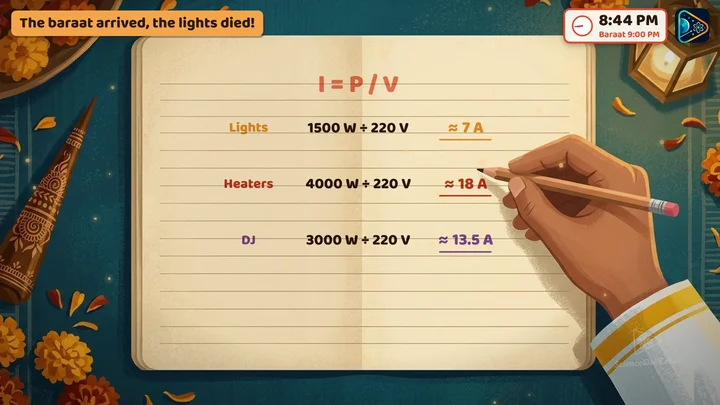
Every appliance also draws its own current, and you can find it straight from the watt rating:
I = P / V
power in watts ÷ voltage in volts = current in amperes
A 1500 W string of lights at 220 V draws 1500 ÷ 220 ≈ 6.8 A. A 3000 W DJ system draws about 13.6 A.
2. All the currents add up in the main wire
The branches split off from one main wire, so every branch current has to come through the main wire first. In parallel:
I_total = I₁ + I₂ + I₃ + …
total power ÷ voltage gives the same answer
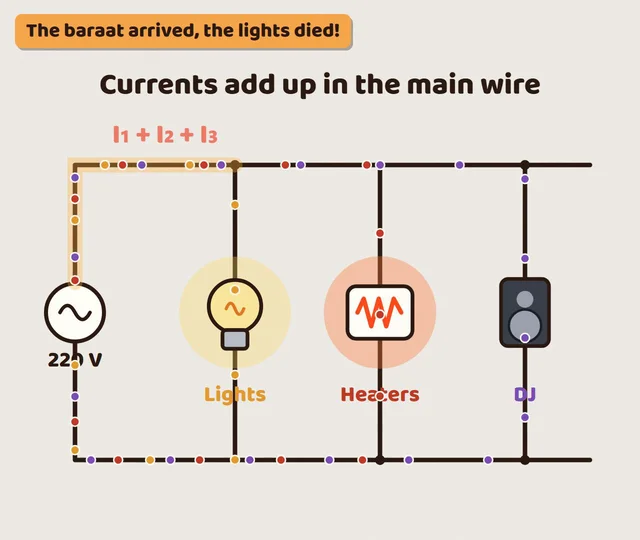
Monu, the bride's brother and a NEET aspirant, compared it to a house fed from one rooftop tank. Every tap gets full pressure, but the more taps you open, the more water rushes through the main pipe from the tank.
3. Monu's calculation: 39 A on a 25 A fuse
| Load | Power | Current I = P/V |
|---|---|---|
| Lights | 1500 W | ≈ 7 A |
| Two heaters | 2 × 2000 = 4000 W | ≈ 18 A |
| DJ | 3000 W | ≈ 13.5 A |
| Total | 8500 W | ≈ 39 A |
The connection's fuse was rated for only 25 A. The fuse made no mistake: it did exactly the job it was made for.
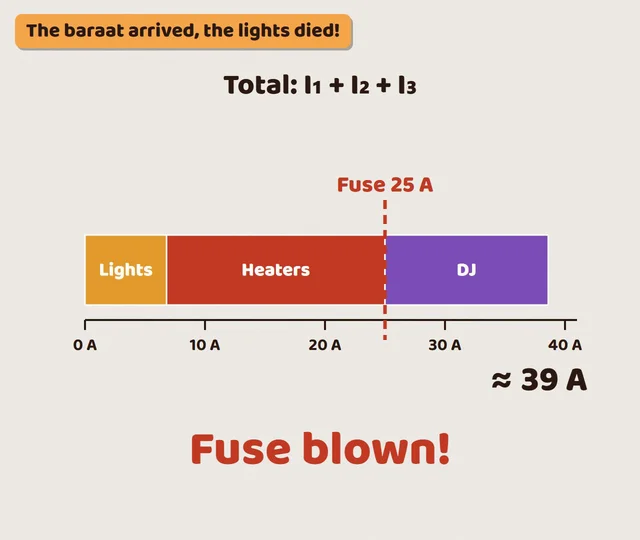
This is called overloading: too many appliances on one circuit, so the total current exceeds what the wiring is rated to carry.
4. Why the wire got hot: P = I²R
Chhotu decided the fuse wire was "fake" and tightened in a thick copper wire instead. The lights came back, and five minutes later the extension wire under the cloth tent was hot and smoking.
Every real wire has some resistance R, and the heat produced in it each second is:
P = I²R
double the current → four times the heat
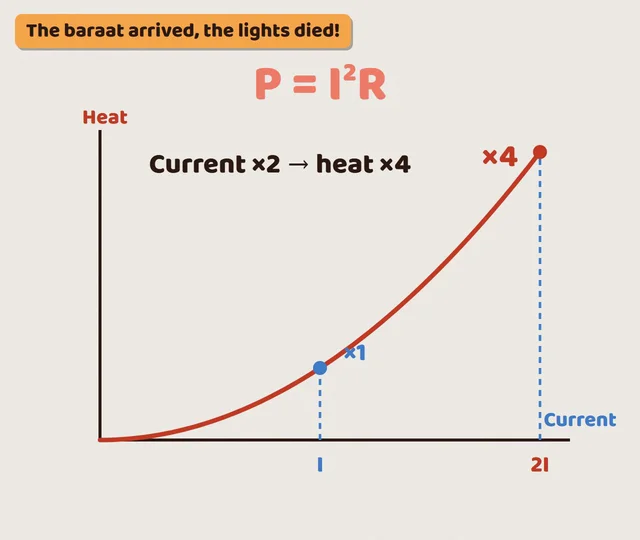
Because of the square, a wire carrying 39 A instead of 20 A makes almost four times as much heat. Thin extension wire under cloth is exactly where that heat cannot escape.
5. A fuse is weak on purpose
A fuse wire is made of a material with a low melting point, chosen so that it melts as soon as the current goes above its rating. It is connected in series with the live wire, so when it melts the whole circuit is cut off before the other wires can overheat.
By fitting copper, which carries far more current before melting, Chhotu removed that guard. The weakest, hottest part of the circuit became the extension wire itself, lying under a cloth tent. That is how electrical fires start.
6. The fix: plan the load
Monu didn't need a bigger fuse; he needed a smaller total current at 9 PM. The halwai heated all the water before the baraat and switched the heaters off (once water boils, more power only makes steam faster, as in the rajma story). Then:
1500 W + 3000 W = 4500 W
I = 4500 / 220 ≈ 20.5 A, comfortably under 25 A
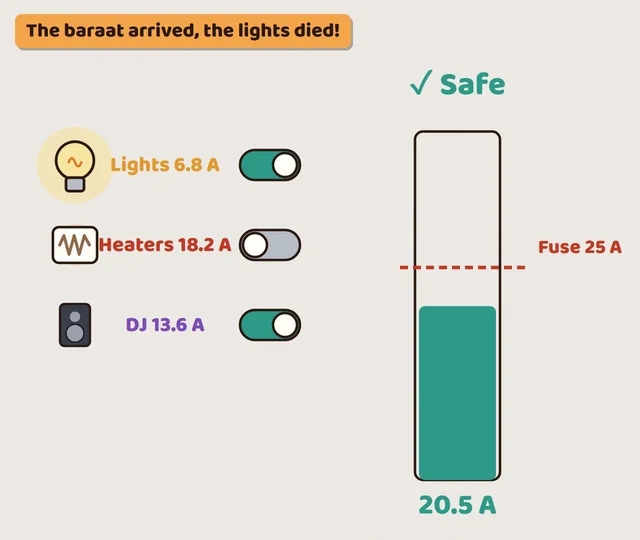
At exactly 9 the dhol played, the groom stepped in, every light blazed, and the fuse didn't blow once. And when Fufaji wanted to plug in his new 2000 W massage chair "in celebration", Monu added another 9 A: 29.5 A, over the limit again. Fufaji put the plug back in his pocket.
7. Practice questions
NCERT Class 10
An electric oven of 2 kW power rating is operated in a domestic electric circuit (220 V) that has a current rating of 5 A. What result do you expect? Explain.
Show answer
The oven draws I = P/V = 2000 ÷ 220 ≈ 9.1 A, almost twice the 5 A rating. The circuit is overloaded: the fuse will blow (or the MCB will trip) and cut off the supply. Without a working fuse the wiring would overheat and could catch fire.
NEET 2024
Two heaters rated 1 kW and 2 kW (at the same voltage) are connected first in series and then in parallel to the same supply. What is the ratio of the total power in the two cases? (Wording paraphrased.)
Show answer
2 : 9. Series: 1/P = 1/1 + 1/2 = 3/2, so P = 2/3 kW. Parallel: P = 1 + 2 = 3 kW. Ratio = (2/3) : 3 = 2 : 9. The full working is in our article Small bulb, big shock.
Class 10
A household circuit has a 15 A fuse at 220 V. Can a 1500 W geyser, a 1000 W iron and a 750 W washing machine run together? What about adding a 2000 W heater?
Show answer
Together: 1500 + 1000 + 750 = 3250 W, so I = 3250 ÷ 220 ≈ 14.8 A, just under 15 A, so yes (with no margin to spare). Adding the 2000 W heater makes 5250 W ≈ 23.9 A, so the fuse blows.
NEET pattern
If the current through a wire is doubled, how does the heat produced in a given time change (resistance constant)?
Show answer
It becomes four times. H = I²Rt, so (2I)² = 4I².
8. The quiz from the video
A 1000 W and a 2000 W heater are connected first in series, then in parallel, to the same supply. What's the ratio of the total power in the two cases?
2 : 9. Find each heater's resistance from R = V²/P: the 1000 W heater has twice the resistance of the 2000 W one. In series the resistances add (3 units), in parallel they combine to 2/3 unit, and P = V²/R, so the powers are in the ratio (1/3) : (3/2) = 2 : 9. Series gives about 667 W, parallel 3000 W.
Remember this
- In parallel every appliance gets the same voltage, but each draws its own current: I = P/V.
- Branch currents add up in the main wire: I_total = I₁ + I₂ + I₃.
- Too many loads on one circuit = overloading; the fuse blows when I_total exceeds its rating.
- Heat in a wire: P = I²R. Double the current, four times the heat.
- A fuse is a low-melting-point wire in series with the live wire. Never replace it with copper.
- Fix overloading by planning the load, not by fitting a bigger fuse.
Syllabus: NCERT Class 10 Science, Electricity (heating effect of current, electric power, fuse) and Magnetic Effects of Electric Current (domestic circuits, overloading); NCERT Class 12 Physics, Current Electricity.
Sources
Keep reading
 B + A = O? The baby wasn't swapped: how ABO blood groups are inherited (multiple alleles)In a maternity ward in Gaya, a group B father and a group A mother were sure the hospital had swapped their group O baby. The ankle tag said otherwise. Learn how the ABO gene works (Iᴬ, Iᴮ and i), why a hidden O can pass from both parents, the 2×2 grid with its four equal chances, and solve the NEET 2024 question.
 Lightning hit our car. Did the tyres save us? Why the electric field inside a conductor is zeroOn the Mohand ghat, lightning struck a wedding taxi and all four people inside walked out fine. The driver thanked the rubber tyres; he was wrong. Learn where the current really went, why charge sits on the outside of a conductor, why the field inside a closed metal shell is zero, and solve the NEET 2019 hollow-sphere question.
 Small bulb, big shock: why a 25 W bulb outshines a 100 W bulb in seriesAt a wedding in Meerut, Chhotu wired a 25 W and a 100 W bulb on one wire and the small one blazed. Learn why, with P = I²R, R = V²/P, the 4 W vs 16 W calculation and a solved NEET 2024 question.