

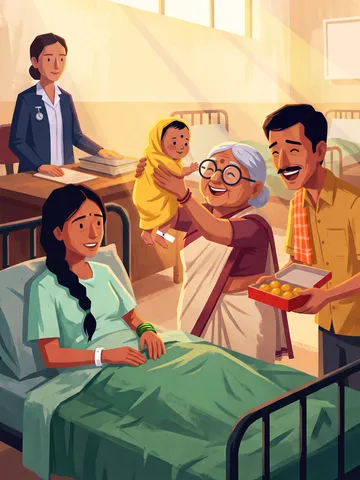
In the maternity ward of a district hospital in Gaya, Bihar, a baby boy is born. The ward does the routine blood-group test, and the report says: Papa Rakesh, group B. Mummy Sunita, group A. Baby, group O.
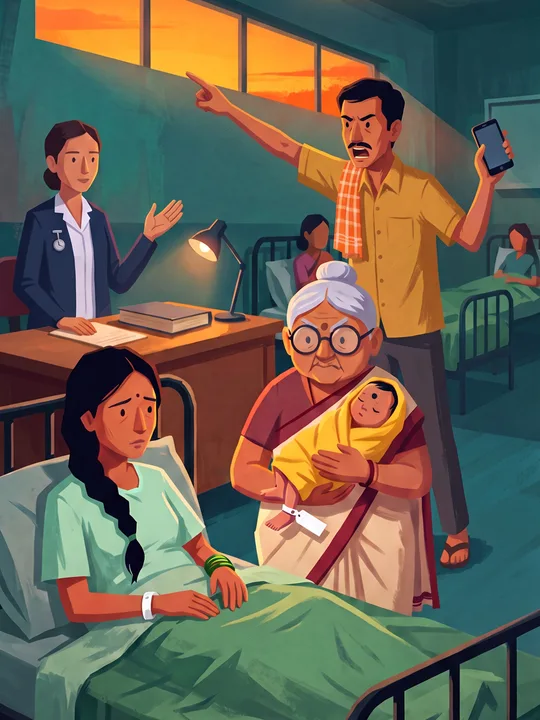
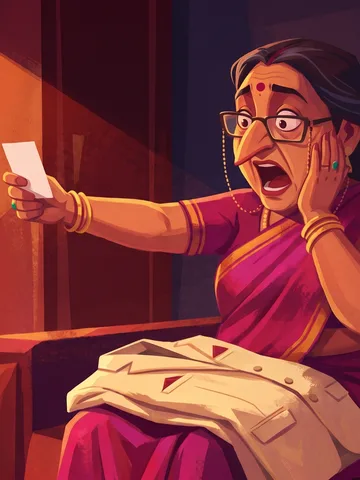
Dadi reads it twice and explodes: "This hospital swapped our baby!" Rakesh is even surer: "B plus A can only make AB! Show me the CCTV!" Dadi points at the baby: "Rakesh's nose, Rakesh's crying, and somebody else's blood?"
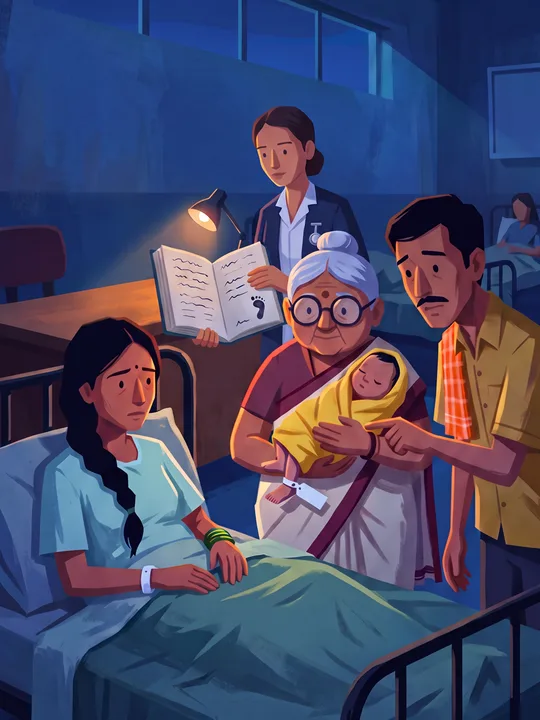
Senior nurse Sister Kiran does not argue. She opens the ward register: "Ankle tag, forty-seven. Wristband, forty-seven. He never left this ward." So how is he group O? Kiran's answer takes three steps, and by the end Dadi has a name ready: Omkar.
1. Everyone carries two gene copies
Your ABO blood group is decided by one gene, called I. Like most genes, you have two copies of it: one from your mother and one from your father.
The gene comes in three versions (alleles):
- Iᴬ puts the "A" sugar on the surface of your red blood cells,
- Iᴮ puts the "B" sugar there,
- i puts no sugar at all.
That is why ABO is the standard NCERT example of multiple alleles: three alleles exist in the population, but any one person carries only two of them.
2. A or B can cover up an O
When Iᴬ or Iᴮ sits next to i, the cell still makes the A or B sugar, because i makes nothing that could show. So Iᴬ and Iᴮ are dominant over i. This means two different genotypes look exactly the same from outside:
| Genotype | What the cells carry | Blood group |
|---|---|---|
| IᴬIᴬ or Iᴬi | A sugar | A |
| IᴮIᴮ or Iᴮi | B sugar | B |
| IᴬIᴮ | both A and B sugars | AB |
| ii | no sugar | O |
Six genotypes give only four blood groups. A blood test shows the group, never the hidden copy. So Rakesh can be Iᴮi, "B plus a hidden O", and Sunita can be Iᴬi, "A plus a hidden O". That is what Kiran means by i = hidden O.
The AB row has a second lesson: when Iᴬ and Iᴮ meet, neither hides the other, and the cell makes both sugars. Two alleles that both show fully are co-dominant. So the ABO gene shows dominance (Iᴬ and Iᴮ over i) and co-dominance (Iᴬ with Iᴮ) at the same time.
3. Only someone with an O can give an O
Each parent passes on one of their two copies to each child, chosen at random. A group O baby is ii, so he must have received one i from his father and one i from his mother. There is no other way to get two i's.
So the baby's blood group does not prove a swap. It proves something about the parents: both Rakesh and Sunita carry a hidden i. And a group AB parent (IᴬIᴮ) has no i to give, so an AB parent can never have a group O child.
4. Four equal chances: the 2×2 grid
Write what each parent can give along the edges of a grid and fill each box with one copy from each side.
Iᴮi × Iᴬi → IᴬIᴮ (AB) : Iᴬi (A) : Iᴮi (B) : ii (O) = 1 : 1 : 1 : 1
each of the four blood groups has a chance of 1 in 4 for every child
This is the cross with the most surprising result in the whole ABO system: one B parent and one A parent can have children of all four blood groups. For Rakesh and Sunita, an O baby had a 1 in 4 chance, the same as an AB baby. Their next child starts again at 1 in 4 for each group; the grid does not remember the first child.
If either parent has no hidden i (IᴮIᴮ or IᴬIᴬ), the bottom row or the right column disappears and O becomes impossible. That is the only case in which Rakesh's "only AB" idea could even be close.
One more thing: a blood group can rule a parent out, but it can never prove one. Thousands of unrelated people share Rakesh's group. Real paternity and baby-mix-up cases are settled with DNA tests (see our DNA fingerprinting story). In Gaya, the tag, the wristband and the register were the proof; the blood groups only had to be possible, and they were.
5. Previous-year question, solved
NEET 2024
As per ABO blood grouping system, the blood group of father is B⁺, mother is A⁺ and child is O⁺. Their respective genotype can be
A. Iᴮi / Iᴬi / ii B. IᴮIᴮ / IᴬIᴬ / ii C. IᴬIᴮ / iIᴬ / Iᴮi D. Iᴬi / Iᴮi / Iᴬi E. iIᴮ / iIᴬ / IᴬIᴮ
Choose the correct answer: A only · B only · C and B only · D and E only
Show answer
A only (Iᴮi / Iᴬi / ii).
- The child is group O, so the child is ii: one i from each parent.
- The father is group B and must have an i to give, so he is Iᴮi. The mother is group A and must have an i, so she is Iᴬi.
- B fails: IᴮIᴮ × IᴬIᴬ can only give IᴬIᴮ (AB), never ii.
- C fails: IᴬIᴮ is group AB, not the father's B, and Iᴮi is group B, not the child's O.
- D fails: the father would be Iᴬi (group A), the mother Iᴮi (group B), and the child Iᴬi (group A), all wrong.
- E fails: the child IᴬIᴮ is group AB, not O.
- The ⁺ signs are the Rh factor, a separate gene: Rh⁺ × Rh⁺ parents can have an Rh⁺ child, so they change nothing here.
The trap: option B looks tidy ("B is IᴮIᴮ, A is IᴬIᴬ"), but such parents could never have an O child. Always start from the child.
(In Code R this is Q194 and "A only" is option (4); in other codes it is option (1). Match the answer by its content, not its number.)
6. Practice questions
Class 12
A man of blood group AB marries a woman of blood group O. Which blood groups are possible in their children, and in what ratio?
Show answer
A and B only, 1 : 1. The man (IᴬIᴮ) gives Iᴬ or Iᴮ; the woman (ii) can only give i. Children are Iᴬi (group A) or Iᴮi (group B), each with a chance of 1 in 2. No child can be AB or O.
NEET pattern
The ABO blood group system in humans is an example of: (1) incomplete dominance only (2) multiple alleles and co-dominance (3) polygenic inheritance (4) pleiotropy
Show answer
(2) multiple alleles and co-dominance. Three alleles (Iᴬ, Iᴮ, i) of one gene exist in the population (multiple alleles), and Iᴬ and Iᴮ are both fully expressed together in group AB (co-dominance). Blood group is not polygenic: it is controlled by one gene.
NEET pattern
How many different genotypes and how many different phenotypes (blood groups) are possible for the ABO gene?
Show answer
6 genotypes, 4 phenotypes. Genotypes: IᴬIᴬ, Iᴬi, IᴮIᴮ, Iᴮi, IᴬIᴮ, ii. Phenotypes: A, B, AB, O. With n alleles there are n(n + 1) ÷ 2 genotypes: 3 × 4 ÷ 2 = 6.
NEET pattern
Both parents are group A, and their first child is group O. What is the probability that their second child is group O?
Show answer
1/4. The O child (ii) shows that both parents are Iᴬi. Iᴬi × Iᴬi gives IᴬIᴬ : Iᴬi : ii = 1 : 2 : 1, so 3/4 group A and 1/4 group O. Each child is a fresh draw, so the first child does not change the second child's chance.
KCET pattern
A child has blood group O. The mother has blood group A. Which of these men cannot be the father: a man of group A, B, AB or O?
Show answer
The man of group AB. The child (ii) needs an i from the father. Men of group A (Iᴬi), B (Iᴮi) or O (ii) can carry an i; a man of group AB (IᴬIᴮ) has no i to give. This is how a blood group can rule a man out, though it can never prove who the father is.
Class 12
Why is a person with the genotype Iᴮi group B and not group O?
Show answer
Because Iᴮ is dominant over i. Iᴮ makes the B sugar on the red blood cells; i makes no sugar at all, so it has nothing to show. The cell carries the B sugar, and the test reads group B. The i is still there, hidden, and half of this person's children will receive it.
7. The quiz from the video
Father AB, mother O. Can their baby be group O?
NO. The father's two copies are Iᴬ and Iᴮ, so he has no hidden i to give. Every child gets Iᴬ or Iᴮ from him and i from the mother: Iᴬi (group A) or Iᴮi (group B), never ii. Only someone who has an O can give an O.
Remember this
- One gene, I, three alleles: Iᴬ, Iᴮ, i. Everyone carries two copies, one from each parent.
- Iᴬ and Iᴮ are dominant over i; Iᴬ and Iᴮ together are co-dominant (group AB).
- 6 genotypes, 4 blood groups. Group A can be Iᴬi and group B can be Iᴮi: a hidden O.
- Group O is ii: one i from each parent. Only someone with an i can give an i.
- Iᴮi × Iᴬi → AB : A : B : O = 1 : 1 : 1 : 1, so a B father and an A mother can have an O baby (1 in 4).
- An AB parent can never have an O child; an O × O couple can only have O children.
- A blood group can rule a parent out, never prove one. Start every genotype question from the child.
Another genetics story: Dad's fault or Nanaji's? (X-linked inheritance and colour blindness). And how a lab really settles who is related to whom: who ate the wedding laddoos? (DNA fingerprinting and PCR).
Syllabus: NCERT Class 12 Biology, Chapter 4 Principles of Inheritance and Variation (inheritance of one gene: co-dominance and multiple alleles, ABO blood groups). NEET unit "Genetics and Evolution"; 2nd PUC Biology for KCET.
Sources
Keep reading
 Where did the blue go? Why coordination compounds are colouredMeera's blue copper sulphate turned white an hour before a Diwali chemistry contest. Learn crystal field splitting, why you see the complementary colour, the spectrochemical series, E = 1240/λ, and solve the NEET 2025 wavelength question.
 36 gunas matched, one letter didn't: sickle-cell trait and the genetic codeFour days before the pheras, Pammi Aunty found Rohan's "sickle cell trait, HbAS" card and called off the wedding. Learn how a cell reads a gene in codons, how one letter (GAG → GTG) swaps glutamic acid for valine, why a carrier (AS) is healthy, the AS × AA and AS × AS Punnett squares, and solve NEET 2024 and NEET 2022.
 Blue or white? Blue-white screening and insertional inactivation, explainedOn Children's Day, intern Faizan kept the shiny blue plates for an investor demo and binned the white ones. Learn the plasmid and its lacZ gene, why X-gal turns blue, insertional inactivation, why ampicillin alone cannot find the recombinants, the 63 base-pair sum, and solve NEET 2013 and the pBR322 BamHI question.