

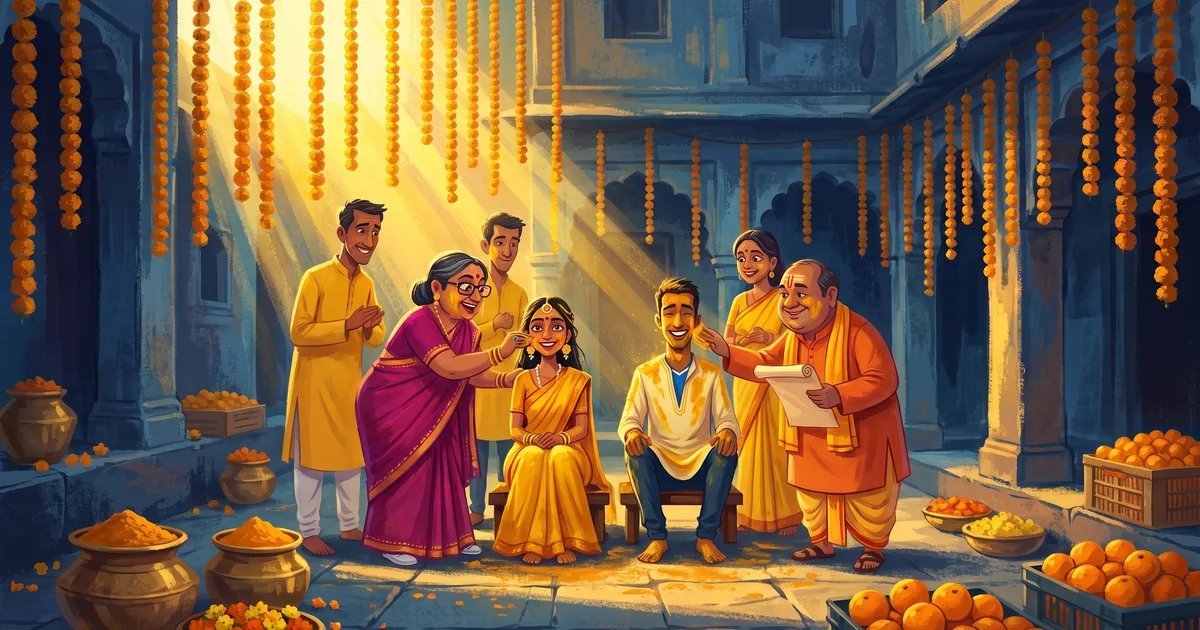
Haldi morning in Nagpur, four days before the pheras. Crates of oranges filled the courtyard, and Pandit-ji looked up from Ananya and Rohan's horoscopes and announced: thirty-six out of thirty-six gunas!
The clapping hadn't stopped when a card fell out of Rohan's jacket into Pammi Aunty's hand. It was from an office health camp, and it said: sickle cell trait, HbAS. Aunty read the words "sickle cell" and nothing else. "Hai Rabba, the boy is sick! Stop the haldi, there will be no wedding!" Within minutes she had pushed a giant blue gemstone onto Rohan's finger and posted a forward on the family group: sickle cell means a lifelong disease. Forwarded many times. Rohan's protest, "Aunty, I play ninety minutes of football every Sunday!", changed nothing.
From a corner of the terrace, Ananya's sister Ishita (Ishu) got up: two years of NEET prep, dark circles, highlighter in hand. "Aunty, the problem isn't the card. It's that nobody read it. Read the gene the way a cell reads it. This whole drama is about one letter."
1. A gene is a recipe written in three-letter words
Ishu dragged over the caterer's empty board. A gene is a recipe written in DNA letters, and DNA has only four: A, T, G and C. The cell reads them three at a time. Each three-letter word is called a codon, and each codon says which amino acid goes into the protein next.
The recipe on Rohan's card is for haemoglobin (the "Hb"), the protein in red blood cells that carries oxygen. One of its chains, the β-globin chain, is 146 amino acids long:
146 amino acids × 3 letters = 438 letters
plus one stop codon at the end
How the cell actually reads it, in two steps:
- Transcription: the DNA recipe is copied into mRNA. The mRNA is built on the template strand, so it has the same sequence as the other strand, the coding strand, with U in place of T.
- Translation: a ribosome reads the mRNA one codon at a time. A tRNA whose anticodon pairs with that codon brings the matching amino acid, and the chain grows like beads on a necklace.
Word 6 of the β-globin recipe is GAG (on the coding strand; the mRNA also reads GAG). GAG brings glutamic acid.
2. One letter swapped: GAG becomes GTG
In Rohan's second copy of the recipe, one letter out of 438 is different. Word 6 reads GTG instead of GAG, and GTG brings a different amino acid: valine.
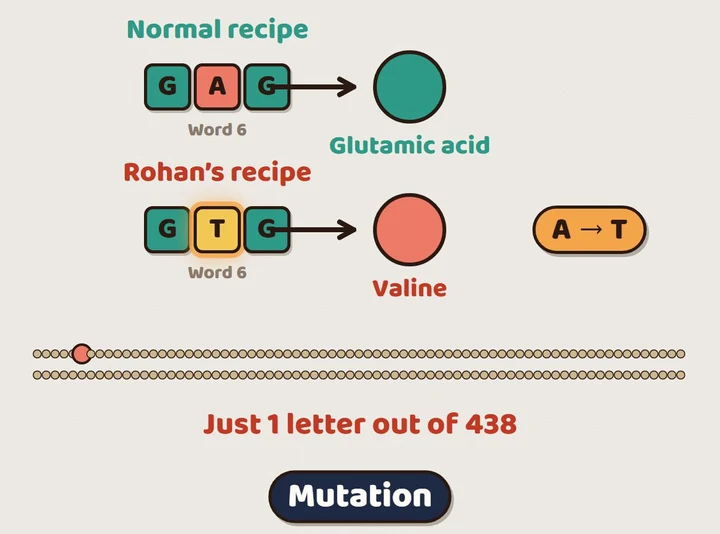
GAG → GTG (DNA) = GAG → GUG (mRNA)
glutamic acid (Glu) → valine (Val) at position 6
One letter in 438 is about 0.23 % of the recipe. A change like this, where one base is replaced by another, is a point mutation, also called a substitution. NCERT writes it with the mRNA codons, GAG → GUG. It is the same change.
A note on numbering: most textbooks call this codon 6. Some count the starting methionine (AUG) as codon 1 and call it codon 7. The amino acid is the same: glutamic acid becomes valine.
Rohan's real fear was "so my recipe is torn?" Ishu's answer is the key exam idea:
- Substitution: one letter is swapped. Only that one word changes; every word after it is read exactly as before.
- Frameshift: one letter is added or deleted. Every word after it slides by one place, so the whole rest of the recipe is misread. That is the "torn book".
| Substitution (point mutation) | Frameshift | |
|---|---|---|
| What happens | one base replaced by another | one base inserted or deleted |
| Reading frame | unchanged | shifted from that point on |
| Effect | at most one amino acid changes | every codon after it changes |
| Example | sickle-cell allele (Glu → Val) | NEET-style "delete base 901" questions |
3. Two copies of the gene: carrier (AS) or disease (SS)
What can one amino acid actually do? If a person's blood has only the changed haemoglobin (HbS), then when oxygen runs low the molecules stick together into long fibres. The round, flexible red cell bends into a sickle, a curved farm blade. Sickled cells are stiff, block small blood vessels and break down early. That is sickle-cell disease.
But every gene comes in two copies, one from each parent. Ishu's analogy: two umbrellas in the rain. One has a hole, and you still stay dry. Rohan's other copy keeps making normal haemoglobin, so he is perfectly healthy. That is why he lasts ninety minutes on the football field.
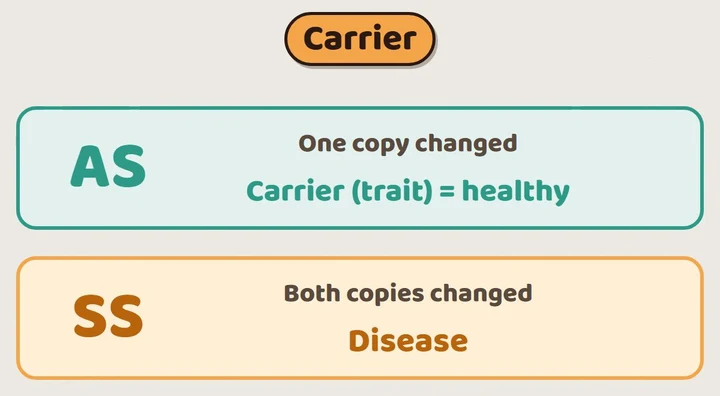
- HbAA: both copies normal.
- HbAS (sickle-cell trait): one normal, one changed. A carrier: healthy, and usually never knows unless tested.
- HbSS (sickle-cell anaemia): both copies changed. This is the disease.
For the disease, the S allele is recessive: it shows only when both copies are S. Sickle-cell anaemia is an autosomal recessive disorder, so it affects boys and girls equally.
4. The children: AS × AA and AS × AS
Aunty's last question was fair: what about the children? Next morning Ananya got screened too: HbAA.
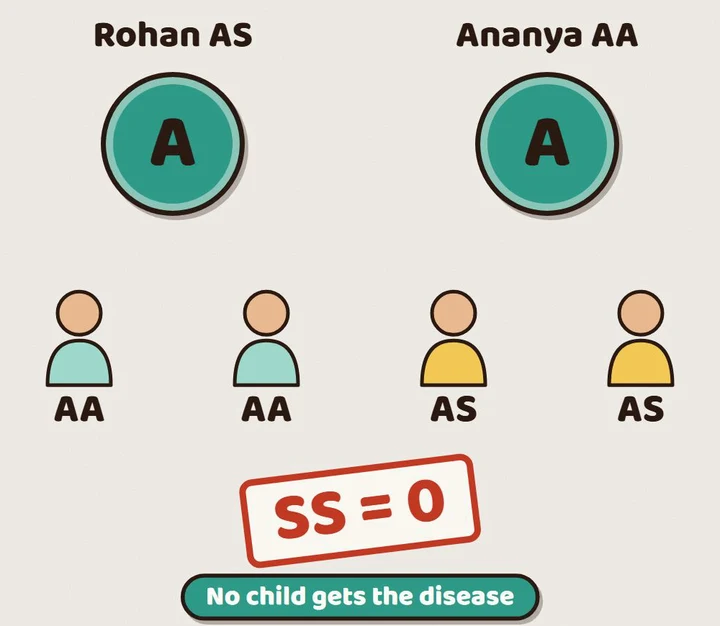
Each parent passes on one of their two copies. Rohan (AS) passes A or S, each half the time. Ananya (AA) always passes A.
| Rohan's A | Rohan's S | |
|---|---|---|
| Ananya's A | AA | AS |
| Ananya's A | AA | AS |
AS × AA → ½ AA + ½ AS
SS = 0: no child can have the disease
If both parents were carriers, the square changes:
| A | S | |
|---|---|---|
| A | AA | AS |
| S | AS | SS |
AS × AS → ¼ AA + ½ AS + ¼ SS
each child: 1 in 4 chance of SS, 1 in 2 chance of being a carrier
These are chances for each child, like tossing a coin each time, not a promise about how many children out of four.
Even then, the answer is not to cancel a wedding. A couple who are both carriers sit down with a doctor or a genetic counsellor and plan together. That is exactly what screening is for.
5. Screening: a card is for reading, not for screaming
Four days later the pheras went ahead. First in line at the wedding's free screening stall was Pammi Aunty herself, and her report said AS: a carrier at sixty-two who walks five kilometres every morning. Pandit-ji printed new cards: guna matching, now with gene matching.
In real life, India's National Sickle Cell Anaemia Elimination Mission, launched on 1 July 2023, plans to screen about 7 crore people aged up to 40 in tribal-majority districts of 17 states. Each person gets a card that shows normal, carrier or disease, and counselling is part of the programme. Its goal is to end sickle-cell anaemia as a public-health problem by 2047.
6. Previous-year questions, solved
NEET 2024
A stretch of the DNA template strand reads 3'-TACATGGCAAATATCCATTCA-5'. What is the sequence of the mRNA made from it? (Wording paraphrased.)
Show answer
5'-AUGUACCGUUUAUAGGUAAGU-3'.
The mRNA is the complement of the template strand, written antiparallel, with U in place of T. Pair each base: T→A, A→U, C→G, G→C.
3'-TACATGGCAAATATCCATTCA-5' (template) → 5'-AUGUACCGUUUAUAGGUAAGU-3' (mRNA)
T→A, A→U, C→G, G→C
Check: the answer starts with AUG, the start codon, which is a good sign. The trap option is the one that just copies the template with U for T.
NEET 2022
If the codon on mRNA is 5'-UAC-3', what is the anticodon on the tRNA? (Wording paraphrased.)
Show answer
5'-GUA-3' (the same as 3'-AUG-5').
The anticodon pairs with the codon antiparallel. Line them up:
codon 5'-UAC-3' pairs with anticodon 3'-AUG-5'
U–A, A–U, C–G
Read the anticodon from its 5' end and you get 5'-GUA-3'. The common mistake is writing 5'-AUG-3', which forgets that the two strands run in opposite directions.
7. Practice questions
Practice
An mRNA of 999 bases codes for a protein of 333 amino acids. The base at position 901 is deleted, so the mRNA is now 998 bases long. How many codons are changed?
Show answer
33. Base 901 is the first base of codon 301 (codon n covers bases 3n − 2 to 3n). Deleting it shifts the frame from codon 301 to the end, so codons 301 to 333 are all read wrongly: 333 − 301 + 1 = 33 codons. The first 300 codons are untouched. This is a frameshift, the "torn book".
Practice
In which disorder does a single base change in the gene for the β-globin chain replace glutamic acid with valine?
Show answer
Sickle-cell anaemia. The sixth codon changes from GAG to GUG (in mRNA), so glutamic acid (Glu) at position 6 is replaced by valine (Val).
Practice
Which mRNA codon at position 6 of the β-globin chain causes sickling: GAG or GUG?
Show answer
GUG. GAG codes for glutamic acid (normal). GUG codes for valine (the sickle allele). In DNA (coding strand) the same change is written GAG → GTG.
Class 12
Distinguish between a point mutation and a frameshift mutation, with one example each.
Show answer
A point mutation (substitution) replaces one base with another; the reading frame stays the same and at most one amino acid changes. Example: sickle-cell anaemia (GAG → GUG, Glu → Val). A frameshift mutation is the insertion or deletion of one or two bases; the reading frame shifts and every codon after it is misread. Inserting or deleting three bases (one codon) keeps the frame.
Class 12
A man who is a sickle-cell carrier (HbAS) marries a woman with normal haemoglobin (HbAA). What are the possible genotypes of their children? Can any child have sickle-cell anaemia?
Show answer
AS × AA gives ½ AA and ½ AS. No child can have sickle-cell anaemia (SS), because the mother always passes on A. Half the children, on average, will be healthy carriers like their father.
NEET pattern
Both parents are carriers (AS). What is the probability that their child is (a) affected, (b) a carrier, (c) normal AA?
Show answer
AS × AS gives ¼ AA, ½ AS, ¼ SS. So (a) 1/4, (b) 1/2, (c) 1/4. The phenotypic ratio (healthy : affected) is 3 : 1, but the genotypic ratio is 1 : 2 : 1.
8. The quiz from the video
Both parents are AS carriers. What is the chance that a child is a carrier, just like them?
1 in 2. Draw the square for AS × AS: AA, AS, AS, SS. Two of the four boxes are AS, so each child has a 1 in 2 chance of being a carrier. "1 in 4" is the chance of SS (the disease), and also the chance of AA. That is the trap.
Remember this
- A gene is read in codons, three bases at a time; each codon sets one amino acid.
- mRNA = complement of the template strand = coding strand with U for T. The anticodon pairs with the codon antiparallel.
- β-globin: 146 amino acids × 3 = 438 bases (plus a stop codon).
- Sickle allele: codon 6 GAG → GUG (DNA GAG → GTG), glutamic acid → valine. One base in 438.
- Substitution changes one codon; a frameshift (insertion or deletion) changes every codon after it.
- AS = carrier (trait), healthy. SS = sickle-cell anaemia. Autosomal recessive.
- AS × AA → ½ AA, ½ AS, no SS. AS × AS → ¼ AA, ½ AS, ¼ SS.
- Screening is good; plan with a doctor or genetic counsellor, never from a forward.
More from the same chapters: DNA fingerprinting and PCR, X-linked inheritance and colour blindness, Blue-white screening.
Syllabus: NCERT Class 12 Biology, Molecular Basis of Inheritance (transcription, genetic code, translation, mutations) and Principles of Inheritance and Variation (Mendelian disorders: sickle-cell anaemia).
Sources
Keep reading
 Blue or white? Blue-white screening and insertional inactivation, explainedOn Children's Day, intern Faizan kept the shiny blue plates for an investor demo and binned the white ones. Learn the plasmid and its lacZ gene, why X-gal turns blue, insertional inactivation, why ampicillin alone cannot find the recombinants, the 63 base-pair sum, and solve NEET 2013 and the pBR322 BamHI question.
 Who makes the antibodies? Active vs passive immunity and the yellow first milkGranny Bebe wanted to throw away the thick yellow first milk, and Pinky Aunty wanted every vaccine "for instant protection". Learn the Y-shaped antibody, active vs passive immunity, why colostrum (IgA) works from day one, why a vaccine needs about two weeks, and solve the NEET 2023 and NEET 2020 questions.
 Lightning hit our car. Did the tyres save us? Why the electric field inside a conductor is zeroOn the Mohand ghat, lightning struck a wedding taxi and all four people inside walked out fine. The driver thanked the rubber tyres; he was wrong. Learn where the current really went, why charge sits on the outside of a conductor, why the field inside a closed metal shell is zero, and solve the NEET 2019 hollow-sphere question.