

It was Children's Day at a biotech campus near Hyderabad. Ten-year-old Kabir had come on a school trip, in a visitor coat two sizes too big, and the intern showing his class around, Faizan, was sweating. In two hours he had to show investors a set of bacteria carrying the insulin gene.
The plates came out of the incubator. Some had shiny blue colonies, some had dull white ones. Faizan lifted the blue plates like the World Cup. "Blue, blue, blue! Straight out of the stadium! And the white ones? Clean bowled!" Into the discard tray they went. At the demo, the investor's assistant tested a blue colony for the insulin chain. Result: zero. One eyebrow went up: "Is this a lab, or the Numaish?"
Kabir pointed at the tray. "Why did you throw out the white ones? Nobody even tested them." Senior scientist Dr. Sravani picked up a white plate. "Faizan, the problem isn't the bacteria. It's how you read the colour."

1. The ring that carries the gene: a plasmid
To make bacteria produce a human protein like insulin, scientists first put the human gene into a vector, a carrier DNA that a bacterium will copy along with its own. The most common vector is a plasmid: a small, circular piece of DNA that lives in a bacterium apart from its main chromosome and copies itself.
A good cloning vector has three things:
- an origin of replication (ori), so it gets copied inside the cell;
- selectable markers, genes such as resistance to ampicillin or tetracycline that help us throw away the cells that did not take up a plasmid;
- cloning sites, places where a restriction enzyme cuts so the foreign gene can be joined in.
Cutting and joining are done with restriction enzymes and DNA ligase. If you have read our article on DNA fingerprinting and PCR, this is the next step: PCR makes many copies of a gene in a tube, and a vector carries that gene into a living cell.
2. Why a colony turns blue: lacZ and X-gal
Many cloning plasmids carry the lacZ gene. lacZ makes the enzyme β-galactosidase (beta-galactosidase).
The plate the bacteria grow on contains X-gal, a chromogenic substrate: it is colourless on its own, but when β-galactosidase cuts it, the product is blue. So a colony turns blue only if it is making a working β-galactosidase.
Now the trick. The cloning site is placed inside lacZ. When the insulin gene is joined in at that site, it sits in the middle of lacZ and breaks it. A broken gene cannot make its enzyme. Follow the chain:
gene inside lacZ → lacZ broken → no β-galactosidase → X-gal not cut → colony stays white
blue = empty plasmid · white = recombinant
This is called insertional inactivation: a gene is inactivated because another piece of DNA was inserted into it.
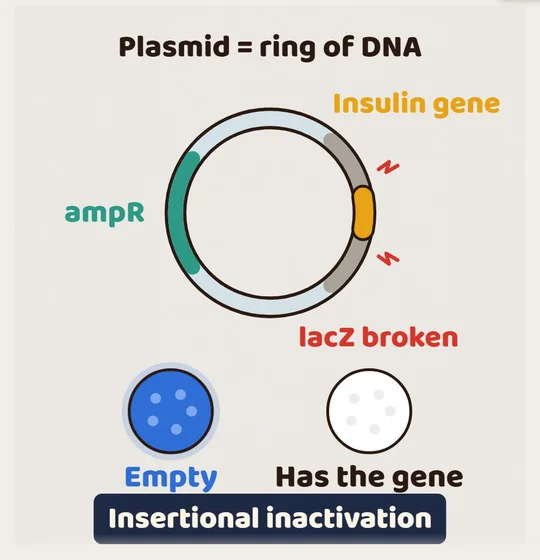
So Faizan had it exactly backwards. The blue colonies held empty plasmids with a working lacZ. The white ones, the ones in the bin, were the recombinants carrying the insulin gene.
3. How can 63 base pairs break a whole gene?
Kabir's next question was fair: "A gene that small can break a gene that big?" Dr. Sravani did the sum.
The A chain of insulin has 21 amino acids. Each amino acid is coded by 3 bases (one codon). The sickle-cell story shows how one changed letter in a codon can change a protein.
21 × 3 = 63 base pairs
plus a stop codon at the end
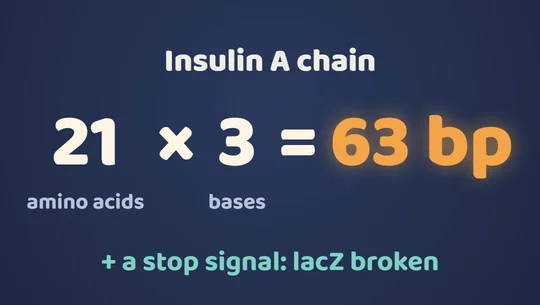
That is tiny next to lacZ, which is more than 3,000 base pairs long. But size does not matter here. A gene is read like a sentence, and pushing 63 extra letters (plus a stop signal) into the middle of it is enough to wreck the instruction. The enzyme is not made, and the colony stays white.
4. Two gates: the antibiotic and the colour
If white means recombinant, why do we need ampicillin at all? Because the two checks answer different questions.
- Gate 1, ampicillin: did the plasmid get in? The plasmid carries the ampicillin-resistance gene. Bacteria that took up no plasmid die on an ampicillin plate. But bacteria with an empty plasmid and bacteria with a recombinant plasmid both survive, because both carry the resistance gene.
- Gate 2, colour: did the gene get in? Among the survivors, only the colour tells the empty plasmids (blue) from the recombinants (white).
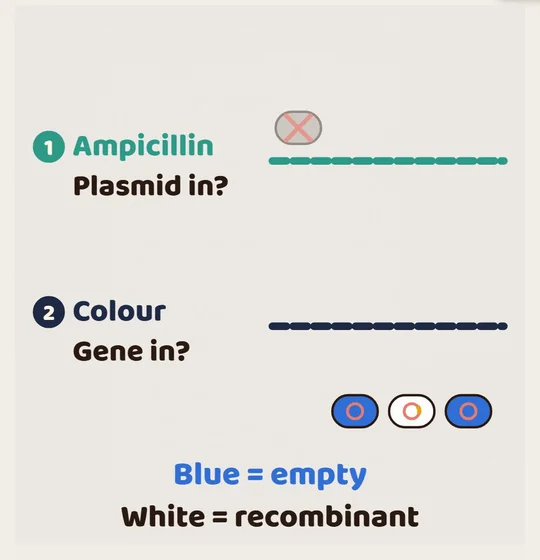
As Dr. Sravani put it: "Ampicillin only tells you the plasmid got in. Whether the gene got in, the colour tells you."
Faizan then counted his plates: 200 colonies, 180 blue and 20 white.
20 ÷ 200 × 100 = 10 %
only one colony in ten carried the insulin gene
The older way: in the vector pBR322, the foreign gene is put into the tetracycline-resistance gene (for example at the BamHI site). The recombinants then grow on ampicillin but not on tetracycline. Finding them needs two plates, one with each antibiotic, and comparing them colony by colony (replica plating). That is slow, and this is why the colour method, which needs just one plate, became so popular.
| Blue colony | White colony | |
|---|---|---|
| Plasmid inside? | yes (it survived ampicillin) | yes (it survived ampicillin) |
| Insert inside lacZ? | no | yes |
| lacZ gene | working | broken (insertional inactivation) |
| β-galactosidase made? | yes | no |
| X-gal | cut, turns blue | not cut, stays colourless |
| What it is | non-recombinant (empty plasmid) | recombinant |
The white colony was tested, the insulin chain showed up, and the eyebrow came down. Faizan: "And that's a SIX!" Kabir's Children's Day gift was his first lab coat, in his size.
5. Previous-year questions, solved
NEET 2013
The colonies of recombinant bacteria appear white in contrast to blue colonies of non-recombinant bacteria because of: (1) non-recombinant bacteria containing β-galactosidase (2) insertional inactivation of α-galactosidase in non-recombinant bacteria (3) insertional inactivation of α-galactosidase in recombinant bacteria (4) inactivation of glycosidase enzyme in recombinant bacteria (Options lightly paraphrased; the paper prints "α".)
Show answer
(3) Insertional inactivation in recombinant bacteria.
Work it out step by step: - Which bacteria are white? The recombinants, so the answer must be about recombinant bacteria. That removes option (2). - Why are they white? The insert sits inside lacZ and inactivates it, so no enzyme is made and X-gal is not cut. That is insertional inactivation, which removes option (4), since "glycosidase" is not the gene that was broken. - Option (1) is a true fact about the blue colonies, but it does not explain why the recombinants are white.
About the "α" in the options: the gene is lacZ and its enzyme is β-galactosidase, not α-galactosidase. The printed "α" is a misprint. Do not let it throw you: in the exam, choose the option that has the right idea, "insertional inactivation ... in recombinant bacteria". In your own answers, always write β-galactosidase.
Class 12
What is a selectable marker? Name two used in cloning vectors.
Show answer
A selectable marker is a gene in the vector that helps to identify and eliminate non-transformants (cells that did not take up the vector) and to keep the transformants. Antibiotic-resistance genes are the usual ones, for example resistance to ampicillin, tetracycline, chloramphenicol or kanamycin. Normal E. coli is not resistant to these, so only cells carrying the vector survive.
Class 12
What is insertional inactivation? Give one example.
Show answer
When a foreign DNA is inserted inside a gene of the vector, that gene stops working. This is insertional inactivation. Examples: an insert in lacZ stops β-galactosidase being made (the colony stays white on X-gal); an insert at the BamHI site of pBR322 inactivates the tetracycline-resistance gene.
NEET pattern
Bacteria were transformed with a plasmid carrying an ampicillin-resistance gene and lacZ, with the insert placed inside lacZ. Why can't an ampicillin plate alone pick out the recombinants?
Show answer
Ampicillin kills only the cells with no plasmid. Cells with an empty plasmid and cells with a recombinant plasmid both carry the ampicillin-resistance gene, so both survive. Ampicillin answers "did the plasmid get in?", not "did the gene get in?". The second question is answered by colour on X-gal: white = recombinant.
KCET pattern
X-gal is colourless. Why does a non-recombinant colony turn blue on it, while a recombinant colony stays white?
Show answer
In a non-recombinant colony, lacZ is intact, so it makes β-galactosidase, which cuts X-gal into a blue product. In a recombinant colony, the insert has broken lacZ, so no enzyme is made, X-gal stays uncut, and the colony stays white (colourless).
Numerical
A plate has 200 colonies: 180 blue and 20 white. What percentage are recombinants? Which colonies would you pick to grow up?
Show answer
Recombinants are the white ones: 20 ÷ 200 × 100 = 10 %. Pick the white colonies. The blue ones carry empty plasmids.
6. The quiz from the video
A gene is inserted at the BamHI site of pBR322. Which resistance does the recombinant lose?
Tetracycline. In pBR322, the BamHI site lies inside the tetracycline-resistance gene (tetR). The insert breaks that gene by insertional inactivation, so the recombinant can no longer grow on tetracycline. The ampicillin-resistance gene is untouched, so it still grows on ampicillin. That is how recombinants are found in pBR322: they grow on ampicillin plates and fail on tetracycline plates.
Remember this
- A plasmid is a small circular DNA used as a cloning vector. It needs an ori, selectable markers and cloning sites.
- lacZ makes β-galactosidase, which cuts the colourless X-gal into a blue product.
- An insert inside lacZ breaks it: insertional inactivation. No enzyme, no blue: the colony stays white.
- Blue = empty plasmid (non-recombinant). White = recombinant.
- Ampicillin only shows that a plasmid got in; the colour shows that the gene got in.
- pBR322: an insert at BamHI (or SalI) breaks tetR, so the recombinant loses tetracycline resistance and keeps ampicillin resistance.
- Insulin A chain: 21 amino acids × 3 = 63 base pairs, plus a stop codon.
- NEET 2013's "α-galactosidase" is a misprint: the lacZ enzyme is β-galactosidase.
Syllabus: NCERT Class 12 Biology, Biotechnology: Principles and Processes (Cloning vectors: origin of replication, selectable marker, cloning sites; insertional inactivation).
Sources
- NCERT Class 12 Biology: Biotechnology: Principles and Processes
- NEET 2013 question paper
Keep reading
 36 gunas matched, one letter didn't: sickle-cell trait and the genetic codeFour days before the pheras, Pammi Aunty found Rohan's "sickle cell trait, HbAS" card and called off the wedding. Learn how a cell reads a gene in codons, how one letter (GAG → GTG) swaps glutamic acid for valine, why a carrier (AS) is healthy, the AS × AA and AS × AS Punnett squares, and solve NEET 2024 and NEET 2022.
 Who makes the antibodies? Active vs passive immunity and the yellow first milkGranny Bebe wanted to throw away the thick yellow first milk, and Pinky Aunty wanted every vaccine "for instant protection". Learn the Y-shaped antibody, active vs passive immunity, why colostrum (IgA) works from day one, why a vaccine needs about two weeks, and solve the NEET 2023 and NEET 2020 questions.
 B + A = O? The baby wasn't swapped: how ABO blood groups are inherited (multiple alleles)In a maternity ward in Gaya, a group B father and a group A mother were sure the hospital had swapped their group O baby. The ankle tag said otherwise. Learn how the ABO gene works (Iᴬ, Iᴮ and i), why a hidden O can pass from both parents, the 2×2 grid with its four equal chances, and solve the NEET 2024 question.