
Home /
Chemistry stories
Every Chemistry episode in order: a short story, the NCERT concept, worked numbers and real exam questions.
 Why turmeric turns red: acids, bases and the fake baba's miracleA yellow cloth turns blood red at a village fair. Learn indicators, acids and bases, the pH scale and neutralization through the story, with worked pH numbers and NEET/JEE-style practice questions.
 Why did the ₹499 catalyst fail? Le Chatelier's principle and the smog from a hot engineIn smoggy Noida, Bunty Uncle tuned his cab to run extra hot and poured in a ₹499 WhatsApp catalyst, yet his niece's NO sensor only beeped louder. Learn how air itself makes NO in a hot engine, why the endothermic N₂ + O₂ ⇌ 2NO shifts right with heat, why a catalyst and pressure cannot shift it, and solve the NEET 2025 question.
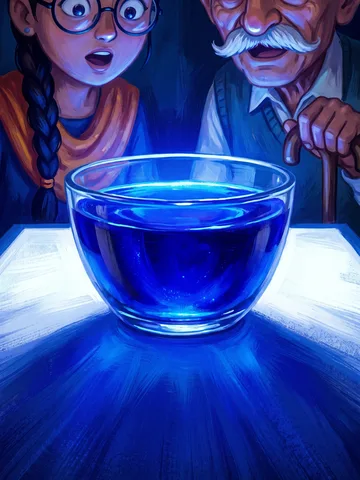 Where did the blue go? Why coordination compounds are colouredMeera's blue copper sulphate turned white an hour before a Diwali chemistry contest. Learn crystal field splitting, why you see the complementary colour, the spectrochemical series, E = 1240/λ, and solve the NEET 2025 wavelength question.
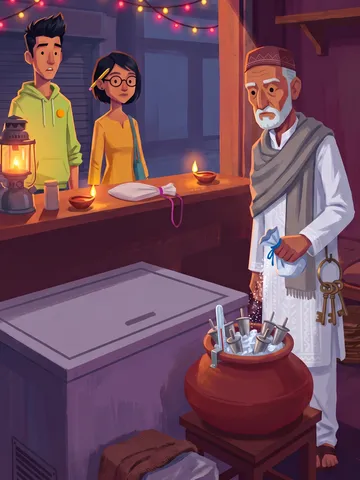 Salt froze the kulfi: why salt makes ice colder and sugar can't (van 't Hoff factor)In a Lucknow kulfi shop three days before Diwali, the freezer died with 300 kulfis due by eight. Plain ice stuck at 0 °C, a kilo of sugar moved the thermometer half a degree, and a kilo of salt took it to −6 °C. Learn why freezing point depends on the number of particles, how ΔTf = i·Kf·m works, and solve the NEET 2025 question.
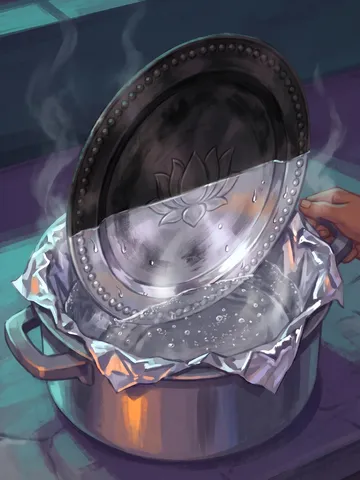 Can ₹2 foil clean a black silver thali? Electrode potential and reducing powerOn Dhanteras in Indore, Dadi's 60-year-old silver puja thali came out black. Bua scrubbed it and the cloth turned grey with silver. Ayaan used kitchen foil and hot soda water instead. Learn what the black layer is, why a more negative electrode potential means a metal gives electrons more easily, why the soda water matters, and solve the NEET 2019 (re-exam) reducing-power question.