

Three days before Diwali, in a family kulfi shop in Lucknow's Aminabad market, the power went. The freezer died at five, and Bobby, the 17-year-old grandson of Ustad Rafiq, had promised 300 kulfis for a Diwali party by eight. A ₹15,000 order. "If it doesn't set," said Ustad drily, "the keys come back."
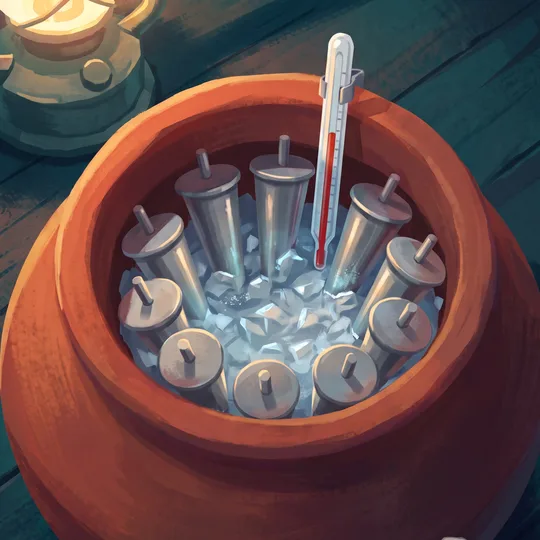
"Relax, Dadu!" Bobby packed the steel moulds into a clay matka full of ice. An hour later the ice water was still sitting at 0 °C, and the sweet kulfi mix needs colder than that. So Bobby had a second idea: "Salt, sugar, both white! Sweet shop, so sugar!" In went a kilo of sugar. His friend Ira, a Class 12 NEET and JEE aspirant, watched her thermometer: it fell half a degree.
"Freezing point doesn't care what you dissolve," said Ira. "Only how many pieces." Ustad poured in a kilo of salt. The red line fell to minus six, and by 7:45 the kulfis were set.

1. Why ice water gets stuck at 0 °C
In a matka of ice and water, two things happen at the same time at the surface of the ice: water molecules leave the ice (melting) and water molecules join the ice (freezing). At 0 °C the two rates are equal, so the mixture stays at 0 °C however long you wait. The heat flowing in from the kulfi and the room only melts a little more ice.
Kulfi mix is milk with a lot of sugar dissolved in it, so it freezes below 0 °C. Ice water at exactly 0 °C cannot freeze it. Bobby needed something that pushes the ice water itself below zero.
2. Dissolved particles stop water from freezing
Dissolve something in the water around the ice. The dissolved particles get in the way: fewer water molecules reach the ice surface per second, so freezing slows down, but melting does not. Now the ice melts faster than it forms, and melting takes heat (latent heat) from everything around it, so the temperature drops. It keeps dropping until it reaches the new, lower freezing point of the solution.
The key fact: the water molecules don't "see" what the particle is. A sugar molecule and a sodium ion block the water about equally. What matters is how many particles there are. Properties that depend only on the number of solute particles are called colligative properties: relative lowering of vapour pressure, elevation of boiling point, depression of freezing point and osmotic pressure.
3. Count the pieces: the van 't Hoff factor
Sugar (sucrose, C₁₂H₂₂O₁₁) dissolves as whole molecules: one molecule gives one particle. Salt (NaCl) splits into two ions, Na⁺ and Cl⁻: one formula unit gives two particles. The number of particles each formula unit gives in solution is the van 't Hoff factor, i.
| Solute | What it gives in water | i (ideal) |
|---|---|---|
| Glucose, sucrose, urea | whole molecules | 1 |
| NaCl, KNO₃ | 2 ions | 2 |
| Na₂SO₄, CaCl₂ | 3 ions | 3 |
| K₄[Fe(CN)₆] | 5 ions | 5 |
| Acetic acid in benzene | pairs (dimers) | about 0.5 |
There is a second reason salt wins: it is lighter. Sucrose has a molar mass of 342 g/mol, NaCl 58.5 g/mol. So one gram of salt has 342 ÷ 58.5 ≈ 5.8 times as many formula units, and each one gives 2 particles:
particles per gram, salt ÷ sugar = (2 / 58.5) ÷ (1 / 342) ≈ 11.7 ≈ 12×
that is the "twelve times" in the video
4. The worked numbers: ΔTf = i·Kf·m
ΔTf = i × Kf × m
Kf of water = 1.86 K kg/mol; m = molality (moles of solute per kg of water)
Take 100 g of solute in 1 kg of water, as in the video.
Sugar: m = 100 / 342 = 0.29 mol/kg, i = 1 → ΔTf = 1 × 1.86 × 0.29 ≈ 0.54 °C
freezing point ≈ −0.5 °C: "just half a degree"
Salt: m = 100 / 58.5 = 1.71 mol/kg, i = 2 → ΔTf = 2 × 1.86 × 1.71 ≈ 6.4 °C
freezing point ≈ −6 °C: kulfi sets

The formula assumes an ideal, dilute solution. At this strength (about 9 % salt) the ions attract each other a little, the effective i is a bit below 2, and the measured freezing point is close to −6 °C, which is the number the thermometer showed. A richer ice-salt mix can go much colder (down to about −21 °C), which is how ice-cream makers and kulfi-walas worked before freezers.
The same particle counting works for boiling: ΔTb = i × Kb × m, with Kb of water = 0.52 K kg/mol. More particles mean a higher boiling point and a lower freezing point.
5. When i is not a whole number: abnormal molar mass
If you measure ΔTf and calculate the molar mass assuming i = 1, an electrolyte seems to have a molar mass that is too small, and a substance that pairs up seems to have one that is too big. These are abnormal molar masses, and the van 't Hoff factor fixes them:
i = normal molar mass ÷ observed molar mass = observed ΔTf ÷ calculated ΔTf (i = 1)
for dissociation into n ions: i = 1 + (n − 1)α, where α is the degree of dissociation
6. Previous-year question, solved
NEET 2025
Which of the following aqueous solution will exhibit highest boiling point? (1) 0.01 M Na₂SO₄ (2) 0.015 M C₆H₁₂O₆ (3) 0.01 M Urea (4) 0.01 M KNO₃
Show answer
(1) 0.01 M Na₂SO₄.
- Boiling point elevation is colligative: ΔTb = i × Kb × m. For dilute aqueous solutions molarity ≈ molality, so compare i × concentration.
- Na₂SO₄ → 2 Na⁺ + SO₄²⁻, so i = 3: 3 × 0.01 = 0.03.
- KNO₃ → K⁺ + NO₃⁻, so i = 2: 2 × 0.01 = 0.02.
- Glucose stays whole, i = 1: 1 × 0.015 = 0.015.
- Urea stays whole, i = 1: 1 × 0.01 = 0.01.
- The largest particle concentration (0.03) gives the highest boiling point: ΔTb ≈ 0.52 × 0.03 ≈ 0.016 K, so it boils at about 100.016 °C.
The trap: glucose has the biggest number on paper (0.015 M), but it gives only one particle per molecule. Count the particles, not the molarity.
(Option order as in Code 48, Q52; the same question is Q79 in Code 45.)
7. Practice questions
NEET pattern
Which 0.1 mol/kg aqueous solution has the lowest freezing point: urea, glucose, NaCl or CaCl₂?
Show answer
CaCl₂. CaCl₂ → Ca²⁺ + 2 Cl⁻, so i = 3 and i × m = 0.3, the most particles. NaCl gives 0.2, urea and glucose 0.1 each. The most particles give the biggest ΔTf and so the lowest freezing point: about −3 × 1.86 × 0.1 = −0.56 °C.
JEE Main pattern
A 0.1 mol/kg aqueous solution of a salt AB (which dissociates into A⁺ and B⁻) freezes at −0.335 °C. Find the van 't Hoff factor and the degree of dissociation. (Kf of water = 1.86 K kg/mol)
Show answer
i ≈ 1.8, α ≈ 0.8 (80 %). i = ΔTf ÷ (Kf × m) = 0.335 ÷ (1.86 × 0.1) = 0.335 ÷ 0.186 ≈ 1.80. For AB → A⁺ + B⁻, i = 1 + α, so α = 0.80.
Class 12
How many grams of NaCl must be dissolved in 1 kg of water to make it freeze at −3.72 °C? (Kf = 1.86 K kg/mol, NaCl = 58.5 g/mol, assume full dissociation)
Show answer
58.5 g. ΔTf = 3.72 = 2 × 1.86 × m, so m = 3.72 ÷ 3.72 = 1 mol/kg. One mole of NaCl is 58.5 g.
8. The quiz from the video
NEET 2025: which boils highest?
0.01 M Na₂SO₄. Count the particles: Na₂SO₄ splits into 2 Na⁺ and 1 SO₄²⁻, so i = 3 and i × M = 0.03. Glucose stays whole: 1 × 0.015 = 0.015. Twice the particles give twice the boiling point rise. The bigger molarity (0.015) is the trap. Solved in full in section 6.
Remember this
- Colligative properties depend on the number of dissolved particles, not on what they are.
- ΔTf = i·Kf·m and ΔTb = i·Kb·m; for water Kf = 1.86 and Kb = 0.52 K kg/mol.
- i = particles per formula unit: glucose and urea 1, NaCl and KNO₃ 2, Na₂SO₄ and CaCl₂ 3.
- Gram for gram, salt gives about 12× the particles of sugar: lighter and it splits in two.
- 100 g in 1 kg of water: sugar ≈ 0.54 °C lower, salt ≈ 6.4 °C lower (measured about −6 °C).
- In "highest boiling point / lowest freezing point" questions, compare i × concentration, never the concentration alone.
Another Chemistry story: why the ₹499 catalyst failed (Le Chatelier's principle). And the other boiling-point story: why the rajma won't cook in the mountains (boiling point and pressure).
Syllabus: NCERT Class 12 Chemistry, Chapter 1 Solutions (colligative properties: elevation of boiling point, depression of freezing point; abnormal molar masses and the van 't Hoff factor). NEET and JEE Main unit "Solutions"; 2nd PUC Chemistry for KCET.
Sources
Keep reading
 Can ₹2 foil clean a black silver thali? Electrode potential and reducing powerOn Dhanteras in Indore, Dadi's 60-year-old silver puja thali came out black. Bua scrubbed it and the cloth turned grey with silver. Ayaan used kitchen foil and hot soda water instead. Learn what the black layer is, why a more negative electrode potential means a metal gives electrons more easily, why the soda water matters, and solve the NEET 2019 (re-exam) reducing-power question.
 Where did the blue go? Why coordination compounds are colouredMeera's blue copper sulphate turned white an hour before a Diwali chemistry contest. Learn crystal field splitting, why you see the complementary colour, the spectrochemical series, E = 1240/λ, and solve the NEET 2025 wavelength question.
 Why did the ₹499 catalyst fail? Le Chatelier's principle and the smog from a hot engineIn smoggy Noida, Bunty Uncle tuned his cab to run extra hot and poured in a ₹499 WhatsApp catalyst, yet his niece's NO sensor only beeped louder. Learn how air itself makes NO in a hot engine, why the endothermic N₂ + O₂ ⇌ 2NO shifts right with heat, why a catalyst and pressure cannot shift it, and solve the NEET 2025 question.