

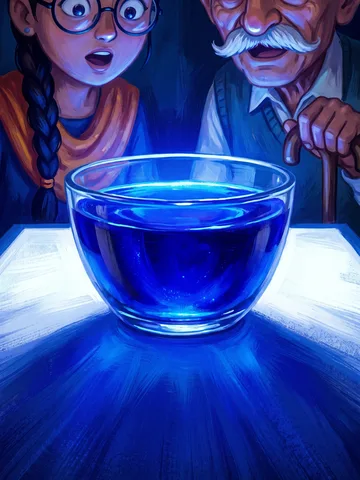
At a school in Lucknow, the Diwali science fair had one contest everyone wanted to win: the chemistry rangoli, glass bowls of coloured solutions glowing on a light table, with a prize of five thousand rupees. The heart of Meera's rangoli was bright blue copper sulphate.
An hour before judging, she found that the blue crystals she had left to dry on the hot light table had turned completely white. She put more crystals under the lamp, and they turned white too. Same copper, so where did the colour go?
The judge, a grumpy retired chemistry teacher, gave her one hint: "The colour isn't in the copper. It's in the copper's clothes."
1. The colour lives in the "clothes": ligands
In blue copper sulphate crystals (CuSO₄·5H₂O), each Cu²⁺ ion is surrounded by water molecules that bond to it through their oxygen lone pairs. Molecules or ions that bond to a central metal ion this way are called ligands, and the metal plus its ligands is a coordination complex.
The ligands are not just decoration. Their electrons push on the metal's five d-orbitals, and because the ligands sit in particular directions, they push some d-orbitals harder than others.
2. Two floors and a gap called Δ
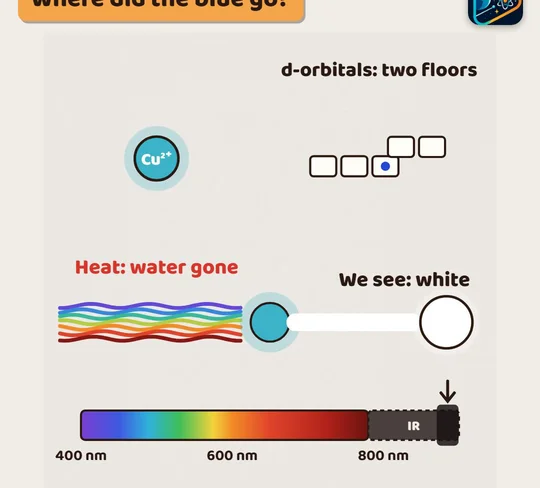
Without ligands, the five d-orbitals have the same energy. In an octahedral complex they split into two sets:
- a lower floor of three orbitals (t₂g),
- an upper floor of two orbitals (e_g).
The energy gap between the floors is the crystal field splitting energy, Δ (Δ₀ for octahedral complexes).
An electron on the lower floor can jump to the upper floor if it absorbs light whose photon energy equals Δ exactly. This is a d–d transition, and it is the reason most transition-metal complexes are coloured.
photon energy = Δ
E = hc/λ, so a bigger Δ means a shorter wavelength λ is absorbed
This is the same photon-energy formula, with the same 1240/λ shortcut, that we used in the photoelectric effect story.
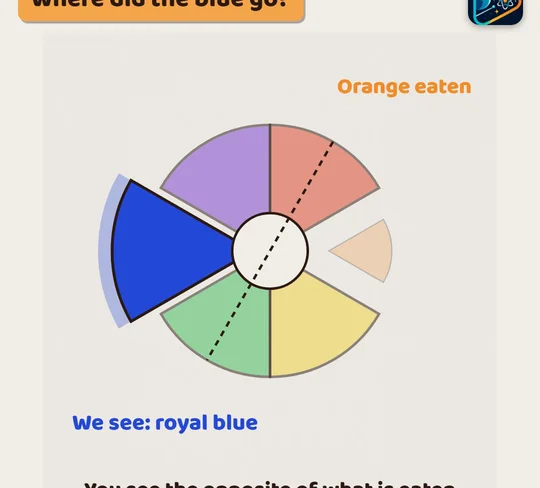
3. You see the colour that is not eaten
For [Cu(H₂O)₆]²⁺, Δ matches red light of about 800 nm. White light goes in, the red part is absorbed, and the light that reaches your eye is the rest, which looks blue. The colour you see is the complementary colour of the light absorbed.
4. Why heat turned the crystals white
Heating drives off the water of crystallisation: CuSO₄·5H₂O → CuSO₄ + 5H₂O. Without the water ligands, the splitting around copper becomes so small that the absorption moves out of the visible range (into the infrared). No visible light is eaten, so the powder looks white. NCERT uses exactly this example: anhydrous CuSO₄ is white, hydrated CuSO₄ is blue.
Meera added a few drops of water to the white powder, and the blue came straight back. Class 10 students know this as a test for water from Acids, Bases and Salts, the chapter behind why turmeric turns red; Class 12 tells you why.
5. A stronger ligand gives a bigger Δ
Ligands can be ranked by how strongly they split the d-orbitals. This ranking is the spectrochemical series (weak to strong):
I⁻ < Br⁻ < Cl⁻ < F⁻ < OH⁻ < H₂O < NH₃ < en < CN⁻ < CO
weak field → strong field
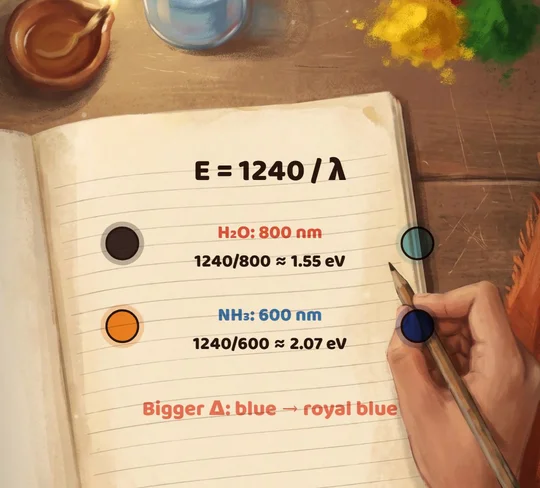
To beat her rival, Meera didn't need more copper (that only makes the same sky blue deeper); she needed a different ligand. In the fume hood, the lab assistant added ammonia. NH₃ replaces water around copper, Δ increases, and the complex now absorbs orange light near 600 nm. Its complementary colour is a deep royal blue.
| Complex | Light absorbed (approx.) | Photon energy E = 1240/λ | Colour seen |
|---|---|---|---|
| Cu²⁺ with water | ~800 nm (red) | 1240/800 ≈ 1.55 eV | sky blue |
| Cu²⁺ with ammonia | ~600 nm (orange) | 1240/600 ≈ 2.07 eV | royal blue |
6. Practice questions
NEET 2025
Arrange the following complexes in order of the wavelength of light they absorb: complexes of the same metal ion with ligands H₂O, NH₃ and CN⁻. (Wording paraphrased.)
Show answer
Wavelength absorbed: H₂O complex > NH₃ complex > CN⁻ complex. The spectrochemical series puts CN⁻ strongest, so it gives the largest Δ, the highest-energy photon and the shortest wavelength. Water gives the smallest Δ and the longest wavelength.
NCERT
Anhydrous CuSO₄ is white, but CuSO₄·5H₂O is blue. Explain.
Show answer
In the hydrated salt, water ligands split the Cu²⁺ d-orbitals and a d–d transition absorbs red light, so the salt looks blue. Without water the splitting is too small to absorb visible light, so the anhydrous salt looks white.
Class 12
[Ti(H₂O)₆]³⁺ absorbs blue-green light (about 498 nm). What colour does the solution appear?
Show answer
Violet (purple), the complementary colour of the absorbed blue-green light.
JEE pattern
A complex absorbs light of wavelength 500 nm. Find the crystal field splitting energy in eV.
Show answer
E = 1240 / 500 ≈ 2.48 eV.
7. The quiz from the video
Two cobalt complexes: [Co(H₂O)₆]³⁺ and [Co(CN)₆]³⁻. Which absorbs the shorter wavelength of light?
[Co(CN)₆]³⁻. CN⁻ is a much stronger-field ligand than H₂O, so Δ is larger, the absorbed photon has more energy, and its wavelength is shorter.
Remember this
- Ligands split the five d-orbitals; in an octahedral complex, 3 go down (t₂g) and 2 go up (e_g), separated by Δ.
- A d–d transition absorbs light whose energy equals Δ: E = hc/λ = 1240/λ (eV, nm).
- You see the complementary colour of the light absorbed.
- No ligand field, no visible absorption: anhydrous CuSO₄ is white.
- Spectrochemical series: I⁻ < Br⁻ < Cl⁻ < F⁻ < OH⁻ < H₂O < NH₃ < en < CN⁻ < CO.
- Stronger ligand → bigger Δ → shorter wavelength absorbed.
Syllabus: NCERT Class 12 Chemistry, Coordination Compounds (crystal field theory, colour in coordination compounds); NCERT Class 10 Science, Acids, Bases and Salts (water of crystallisation).
Sources
Keep reading
 Salt froze the kulfi: why salt makes ice colder and sugar can't (van 't Hoff factor)In a Lucknow kulfi shop three days before Diwali, the freezer died with 300 kulfis due by eight. Plain ice stuck at 0 °C, a kilo of sugar moved the thermometer half a degree, and a kilo of salt took it to −6 °C. Learn why freezing point depends on the number of particles, how ΔTf = i·Kf·m works, and solve the NEET 2025 question.
 Can ₹2 foil clean a black silver thali? Electrode potential and reducing powerOn Dhanteras in Indore, Dadi's 60-year-old silver puja thali came out black. Bua scrubbed it and the cloth turned grey with silver. Ayaan used kitchen foil and hot soda water instead. Learn what the black layer is, why a more negative electrode potential means a metal gives electrons more easily, why the soda water matters, and solve the NEET 2019 (re-exam) reducing-power question.
 Why did the ₹499 catalyst fail? Le Chatelier's principle and the smog from a hot engineIn smoggy Noida, Bunty Uncle tuned his cab to run extra hot and poured in a ₹499 WhatsApp catalyst, yet his niece's NO sensor only beeped louder. Learn how air itself makes NO in a hot engine, why the endothermic N₂ + O₂ ⇌ 2NO shifts right with heat, why a catalyst and pressure cannot shift it, and solve the NEET 2025 question.