

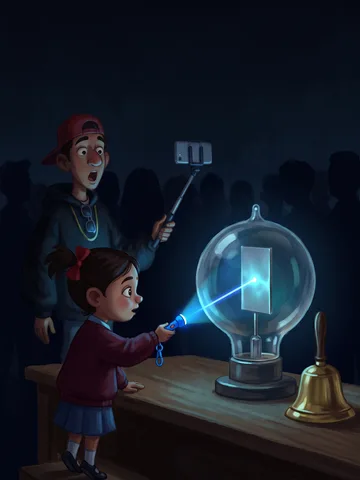
At Lucknow's science fair, Professor Tripathi had a strange challenge: a glass bulb with a potassium plate inside, wired to a brass bell. Shine light on the plate, ring the bell, win ₹10,000.
Show-off Bunty went live on Instagram and brought his uncle's thousand-watt red wedding floodlight. Then two more. Three thousand watts of red light, and the bell didn't make a sound.
His nine-year-old sister Chhutki pointed a ₹10 blue keychain LED at the plate. Ting! The bell rang.
1. Light comes in packets
Light delivers its energy in tiny packets called photons. When light hits a metal, one photon gives all its energy to one electron. Photons can't team up: a billion weak photons can't do what one strong photon does.
The energy of each photon depends only on its frequency (its colour):
E = hν = hc/λ
handy form: E (in eV) ≈ 1240 ÷ λ (in nm)
Red light has the lowest frequency of visible light, so red photons are the weakest. Blue and violet photons are the strongest. The same 1240 ÷ λ shortcut also explains why coordination compounds are coloured.

2. The work function is the entry ticket
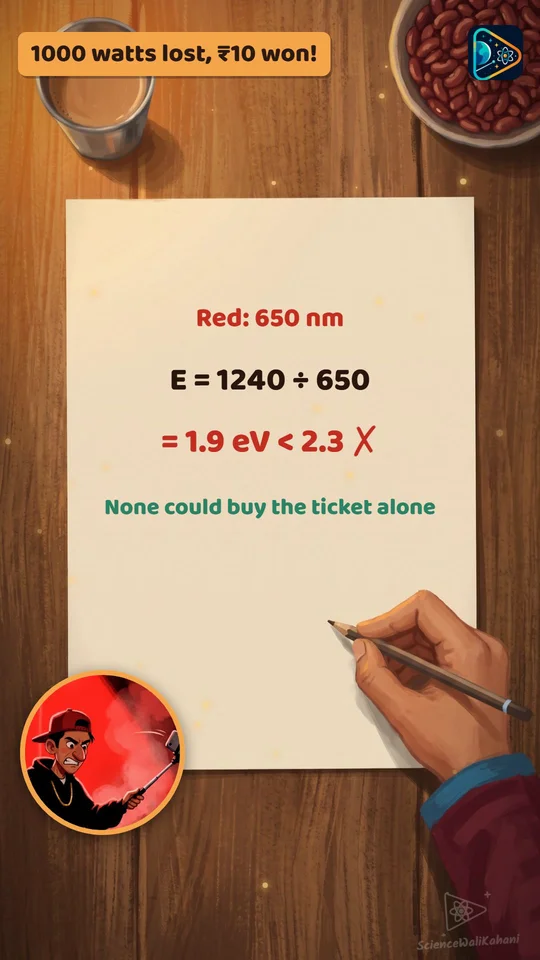
An electron is held inside the metal. To pull one out, a single photon must pay at least the work function (φ). For potassium, φ ≈ 2.3 eV.
Think of it as a ride ticket at the fair: each photon has to buy the ticket on its own.
red, 650 nm: E = 1240 ÷ 650 ≈ 1.9 eV < 2.3 eV ✗
no electron comes out, however bright the light
3. Einstein's equation: what's left over becomes speed
If the photon's energy is more than the work function, the electron comes out, and the extra becomes its maximum kinetic energy:
KE(max) = hν − φ
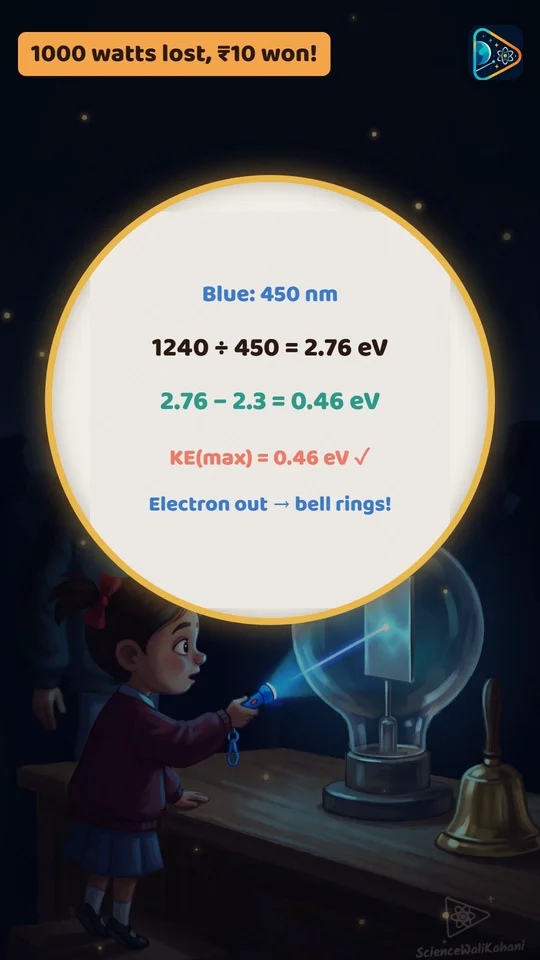
blue 450 nm: 1240 ÷ 450 ≈ 2.76 eV → 2.76 − 2.3 = 0.46 eV
The stopping potential is the reverse voltage that just stops these fastest electrons, so e·V₀ = KE(max). Here V₀ ≈ 0.46 V.
The lowest frequency that can still eject electrons is the threshold frequency, ν₀ = φ/h. For potassium the threshold wavelength is 1240 ÷ 2.3 ≈ 540 nm (green). Anything redder never works.
4. So what does brightness do?
Brightness (intensity) is how many photons arrive each second, not how strong each one is. A lamp's watt rating is its total power, the same P as in the series and parallel bulbs story, so for one colour it sets the photon count, not the energy of each photon.
| Change | Number of electrons (photocurrent) | KE(max) and stopping potential |
|---|---|---|
| Brighter light, same colour | goes up | no change |
| Higher frequency (bluer), same brightness | about the same | goes up |
| Frequency below threshold | zero, at any brightness | — |
5. Practice questions
JEE Main 2025 (29 Jan, evening shift)
In an experiment with the photoelectric effect, the stopping potential: (A) is 1/e times the maximum kinetic energy of the emitted photoelectrons (B) increases with increase in the intensity of the incident light (C) decreases with increase in the intensity of the incident light (D) increases with increase in the wavelength of the incident light
Show answer
(A). e·V₀ = KE(max), so V₀ = KE(max)/e. It doesn't depend on intensity (B and C are wrong), and a longer wavelength means lower photon energy, so V₀ goes down (D is wrong).
NEET pattern
Light of a fixed frequency (above threshold) falls on a metal. If its intensity is doubled, the maximum kinetic energy of the photoelectrons: (a) doubles (b) halves (c) stays the same (d) becomes four times
Show answer
(c) stays the same. Doubling intensity doubles the number of photons, so it doubles the photocurrent, but each photon still has the same energy hν.
Class 12
Find the threshold wavelength for a metal whose work function is 2.3 eV.
Show answer
λ₀ = 1240 ÷ 2.3 ≈ 540 nm (green). Light with a longer wavelength than this can't eject electrons.
Class 12
Light of wavelength 400 nm falls on potassium (φ = 2.3 eV). Find KE(max) and the stopping potential.
Show answer
E = 1240 ÷ 400 = 3.1 eV. KE(max) = 3.1 − 2.3 = 0.8 eV, so V₀ = 0.8 V.
NEET / JEE
Why does a very bright red lamp fail to eject electrons from potassium while a dim violet lamp succeeds?
Show answer
Emission is decided photon by photon. Each red photon (about 1.9 eV) has less energy than the 2.3 eV work function, and photons can't combine. Each violet photon (about 3 eV) has more than enough, so even a dim violet lamp ejects some electrons.
6. The quiz from the video
If Chhutki's blue torch is made ten times brighter, what happens to the electrons' maximum speed?
It stays the same. Ten times brighter means ten times more photons, so about ten times more electrons and current. But each photon still carries 2.76 eV, so each electron still gets at most 0.46 eV, and its maximum speed doesn't change.
Remember this
- Light comes in photons: E = hν, or E (eV) ≈ 1240 / λ (nm).
- One photon frees at most one electron; photons don't team up.
- KE(max) = hν − φ, and e·V₀ = KE(max).
- Below the threshold frequency there is no emission, at any brightness.
- Brightness changes the number of electrons, not their maximum energy.
Syllabus: NCERT Class 12 Physics, Dual Nature of Radiation and Matter.
Sources
Keep reading
 Why did the ₹499 catalyst fail? Le Chatelier's principle and the smog from a hot engineIn smoggy Noida, Bunty Uncle tuned his cab to run extra hot and poured in a ₹499 WhatsApp catalyst, yet his niece's NO sensor only beeped louder. Learn how air itself makes NO in a hot engine, why the endothermic N₂ + O₂ ⇌ 2NO shifts right with heat, why a catalyst and pressure cannot shift it, and solve the NEET 2025 question.
 Lightning hit our car. Did the tyres save us? Why the electric field inside a conductor is zeroOn the Mohand ghat, lightning struck a wedding taxi and all four people inside walked out fine. The driver thanked the rubber tyres; he was wrong. Learn where the current really went, why charge sits on the outside of a conductor, why the field inside a closed metal shell is zero, and solve the NEET 2019 hollow-sphere question.
 The baraat arrived, the lights died: why the fuse kept blowingChhotu wired every light in parallel, yet at 8:30 the whole pandal went dark. Learn I = P/V, why currents add up in the main wire, P = I²R heating, why a fuse must never be replaced by copper, and solve the NCERT 2 kW oven question.