

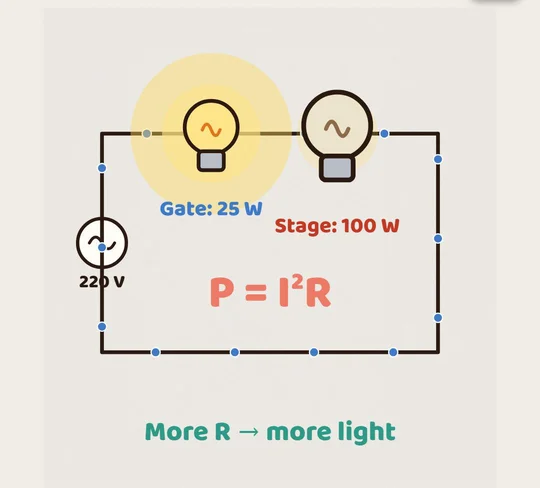
It was the mehndi night of Pinky didi's wedding in Meerut, and the lighting contract went to tent-man Chhotu. He was short of wire, so on one single wire he hung a small 25 W bulb at the gate and, further along the same wire, a big 100 W bulb over the stage.
The switch went on and everything went backwards. The little gate bulb blazed. The 100 W bulb on the stage just flickered, and the bride sat in the dark. Fufaji refused to pay a single rupee. In a panic Chhotu added an even bigger 200 W bulb to the same wire, and the stage got darker still.
Then the bride's brother Monu, a NEET aspirant, took one look at the wire and started laughing.

1. One wire means one current
When bulbs sit one after another on a single path, they are in series. There is only one road for the charge, so the same current I flows through every bulb. Current is not "used up" by the first bulb; what goes in one end comes out the other.
If the current is the same, the brightness depends only on the resistance:
P = I²R
same I → bigger R glows brighter
2. A bigger watt rating means a smaller resistance
The number printed on a bulb tells you its power at its rated voltage (here 220 V). From P = V²/R:
R = V²/P
100 W: 220²/100 = 484 Ω · 25 W: 220²/25 = 1936 Ω
So the "weak" 25 W bulb has four times the resistance of the 100 W bulb. A 100 W filament is thicker so that, on its own across 220 V, it can draw more current.
3. Monu's calculation
In series the resistances add:
R_total = 484 + 1936 = 2420 Ω
I = 220 / 2420 ≈ 0.09 A
Now give each bulb its share with P = I²R (taking the resistances as constant, as NCERT problems do):
| Bulb | Resistance | Power in series |
|---|---|---|
| 100 W (stage) | 484 Ω | (0.0909)² × 484 ≈ 4 W |
| 25 W (gate) | 1936 Ω | (0.0909)² × 1936 ≈ 16 W |
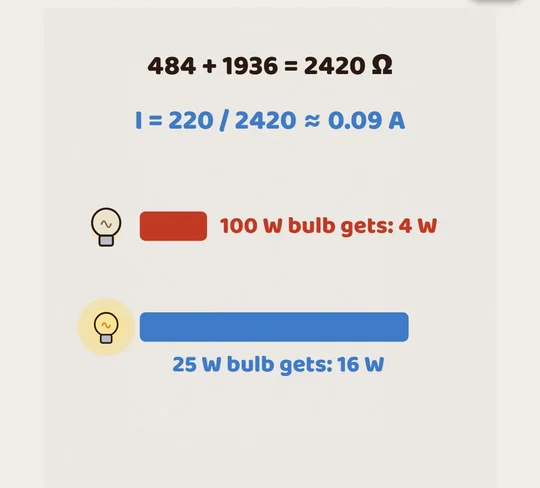
That is also why Chhotu's 200 W bulb made things worse: its resistance is only 242 Ω, so it added little resistance and took the smallest share of all.
4. Parallel: every bulb gets the full 220 V
Monu took a second wire and connected each bulb straight across the main line, like the rungs of a ladder. That is parallel. Now every bulb has the full 220 V across it, so each one gives exactly its rated power: the 100 W bulb finally blazes at 100 W.
parallel: same V across each bulb
brightness follows the watt rating
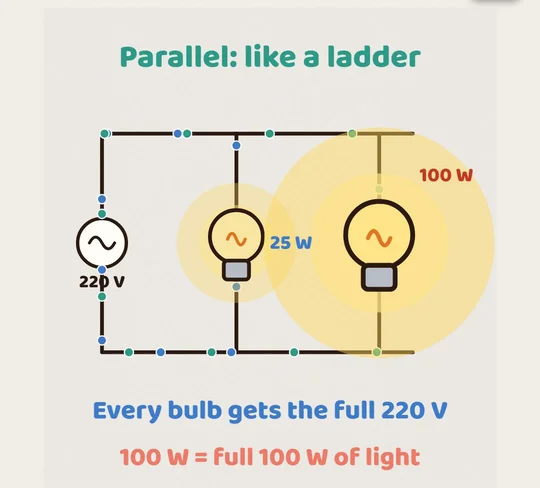
This is why house wiring is always parallel: every appliance gets the full mains voltage, and switching one off does not switch off the rest. But every appliance also adds its current to the main wire, which is how the fuse kept blowing at the baraat.
5. "But series saves electricity!"
Fufaji wasn't convinced: "Chhotu's way would have made the bill smaller, no?"
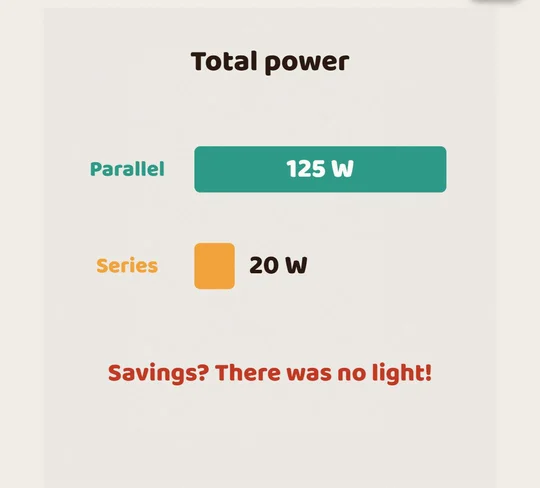
True, but only because hardly any light was produced. In series both bulbs together used 4 + 16 = 20 W. In parallel they use 25 + 100 = 125 W and actually light the stage. As Monu said, if you love saving electricity that much, just switch them off!
A watt rating is total energy per second, not the energy of each packet of light; that difference is the whole story of the photoelectric effect.
A neat shortcut for two rated devices on the same voltage:
series: 1/P = 1/P₁ + 1/P₂
parallel: P = P₁ + P₂
6. Practice questions
NEET 2024
Two heaters rated 1 kW and 2 kW (at the same voltage) are connected first in series and then in parallel to the same supply. What is the ratio of the total power in the two cases? (Wording paraphrased.)
Show answer
2 : 9. Series: 1/P = 1/1 + 1/2 = 3/2, so P = 2/3 kW. Parallel: P = 1 + 2 = 3 kW. Ratio = (2/3) : 3 = 2 : 9.
NEET pattern
A 100 W and a 25 W bulb, both rated for 220 V, are connected in series across 220 V. Which glows brighter, and why?
Show answer
The 25 W bulb. It has four times the resistance (1936 Ω vs 484 Ω). The same current flows through both, and P = I²R, so it gets four times the power (16 W vs 4 W).
Class 10
Why are household appliances connected in parallel and not in series?
Show answer
In parallel each appliance gets the full mains voltage and works at its rated power, each can be switched on or off independently, and one failure does not cut the others off. In series the voltage would be shared and one broken appliance would break the whole circuit.
JEE pattern
Three identical bulbs are in series across a supply, and each gives power P. If they are instead connected in parallel across the same supply, what is the total power?
Show answer
27P. In series each bulb gets V/3, so P = (V/3)²/R = V²/9R. In parallel each bulb gets the full V, so each gives V²/R = 9P, and the three together give 27P.
7. The quiz from the video
A 1000 W heater and a 2000 W heater are connected in series. Which one gets hotter?
The 1000 W heater. It has twice the resistance (R = V²/P), the same current flows through both, and P = I²R, so it produces twice the heat of the 2000 W heater. In series the lower-rated device wins.
Remember this
- Series: same current through every device, so P = I²R: the bigger R takes more power.
- Parallel: same voltage across every device, so P = V²/R: the bigger watt rating wins.
- A higher watt rating means a lower resistance: R = V²/P.
- 100 W and 25 W at 220 V: 484 Ω and 1936 Ω; in series they get 4 W and 16 W.
- Two rated devices: series 1/P = 1/P₁ + 1/P₂, parallel P = P₁ + P₂.
- Homes are wired in parallel.
Syllabus: NCERT Class 10 Science, Electricity (resistors in series and parallel, electric power); NCERT Class 12 Physics, Current Electricity.
Sources
Keep reading
 The baraat arrived, the lights died: why the fuse kept blowingChhotu wired every light in parallel, yet at 8:30 the whole pandal went dark. Learn I = P/V, why currents add up in the main wire, P = I²R heating, why a fuse must never be replaced by copper, and solve the NCERT 2 kW oven question.
 Lightning hit our car. Did the tyres save us? Why the electric field inside a conductor is zeroOn the Mohand ghat, lightning struck a wedding taxi and all four people inside walked out fine. The driver thanked the rubber tyres; he was wrong. Learn where the current really went, why charge sits on the outside of a conductor, why the field inside a closed metal shell is zero, and solve the NEET 2019 hollow-sphere question.
 Zero gravity up there? Why astronauts float, and how strong gravity really is 400 km upAt a Mysuru sweet shop, Sunny bet that a 48-newton box of Mysore pak would weigh zero in space. His sister Kavya dropped the box with its spring balance and the needle hit zero, yet gravity never left. Learn why weightlessness is free fall, how g falls with height as g' = g(R/(R+h))², and solve the NEET 2025 question.