

It was the week before Diwali, and Mani Mama's Mysore pak shop in Mysuru's Devaraja Market was buried in orders. Boxes were stacked to the ceiling, and a big brass spring balance hung over the counter. Thirteen-year-old Sunny, a cardboard "Gaganyaan" badge on his shirt, lifted a box over his head. "Mama, astronauts float, right? So up there, gravity is zero. This 48-newton box would weigh nothing in space!"
"Oho!" boomed Mama, who never said no to a bet. "Lose, and you pack two hundred boxes on Diwali night!"
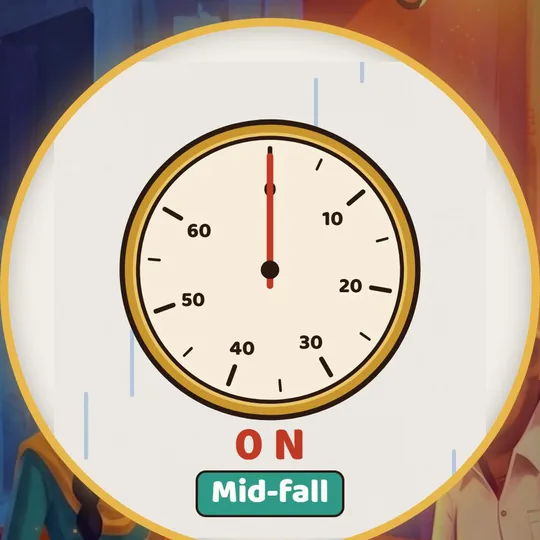
His elder sister Kavya, a NEET aspirant, did not even look up from her notes. "Wait. Floating doesn't mean zero gravity." She hung the box on the spring balance (the needle read 48), then dropped the balance and the box together onto a cushion. For that half-second, the needle swung to zero.

1. Floating is not "no gravity", it is falling
What does a spring balance actually measure? Not gravity itself. It measures how hard the spring has to pull up to hold the box still. Hanging at rest, the spring pulls up with 48 N, exactly balancing the 48 N of gravity, so the needle reads 48.
Now let go of the balance too. The box and the balance fall together, at the same acceleration g. The spring no longer has to hold anything up, so it is not stretched, and the needle reads zero. But gravity is still pulling the box down with the full 48 N. That is why it falls!
reading of the scale = m(g − a)
at rest a = 0 → reads mg = 48 N; in free fall a = g → reads 0
This is weightlessness: not the absence of gravity, but the feeling (and the scale reading) you get when you and everything around you fall freely together. An astronaut on a space station is in exactly this state. The station is falling towards Earth all the time, but it is also moving sideways so fast (about 7.7 km/s) that the ground keeps curving away beneath it. It falls around the Earth, forever. That is an orbit.
2. Gravity weakens with distance from Earth's centre
Gravity does get weaker as you go up, but slowly, and not because of the air. Newton's law says the pull falls with the square of the distance from Earth's centre:
F = GMm / r²
r is measured from the centre of the Earth, not from the ground
On the surface, r = R (Earth's radius, about 6,371 km). At a height h above the surface, r = R + h. Dividing the two gives the result every NEET and JEE student needs:
g' = g × (R / (R + h))²
the same factor scales the force: F' = F × (R / (R + h))²
There is also a shortcut you will see in textbooks: g' ≈ g(1 − 2h/R). It comes from the exact formula, but only works when h is much smaller than R (a few hundred kilometres at most). For heights comparable to Earth's radius, always use the exact square.
3. The worked number: 400 km up
India's Gaganyaan is planned for a low orbit about 400 km above the Earth, the same height as the International Space Station. How strong is gravity there?
r = R + h = 6371 + 400 = 6771 km
(6371 / 6771)² = (0.9409)² ≈ 0.885
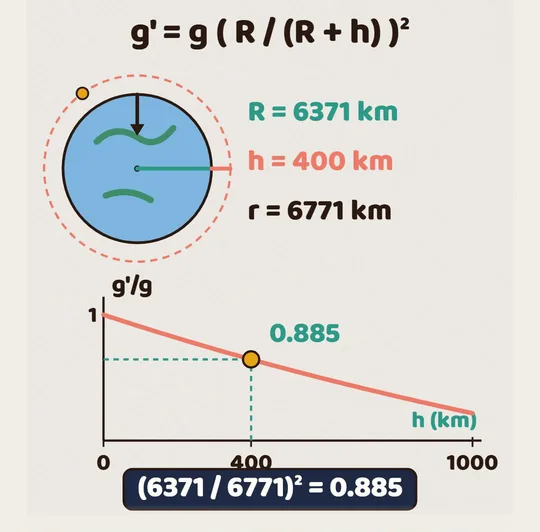
So at 400 km, gravity is still about 88.5 % of what it is on the ground. Kavya's box:
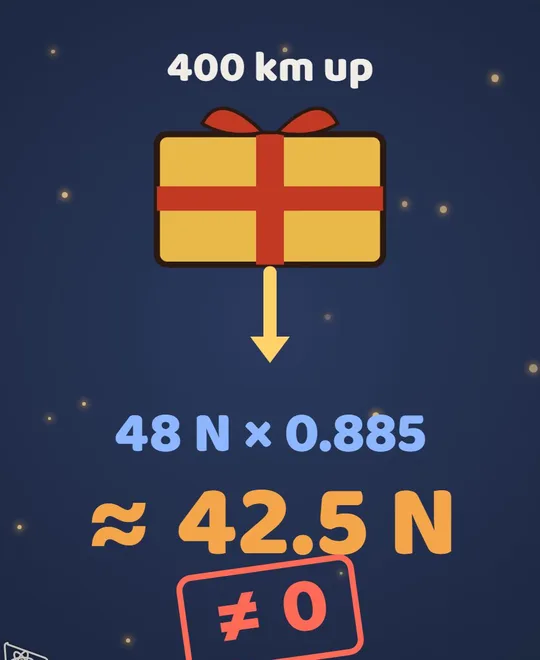
F' = 48 N × 0.885 ≈ 42.5 N
not zero, not even close
Sunny lost the bet. On Diwali night he packed boxes, in an astronaut pose. Mani Mama had the last word: "Gravity is like Mysore pak. Once it grabs you, it never lets go!"
4. Weight, mass and "apparent weight"
Three words that students mix up:
| Word | What it is | On Earth | 400 km up | In free fall |
|---|---|---|---|---|
| Mass m | amount of matter (kg) | 4.9 kg | 4.9 kg | 4.9 kg |
| Weight (force of gravity) mg' | Earth's pull on it | 48 N | ≈ 42.5 N | still acts in full |
| Scale reading (apparent weight) | how hard a support pushes back | 48 N | 0 if the scale orbits with it | 0 |
(The 4.9 kg box: 48 N ÷ 9.8 m/s² ≈ 4.9 kg.) Mass never changes. Gravity's pull changes slowly with height. Only the scale reading drops to zero, and only because the scale is falling too.
5. Previous-year question, solved
NEET 2025
A body weighs 48 N on the surface of the earth. The gravitational force experienced by the body due to the earth at a height equal to one-third the radius of the earth from its surface is: (1) 27 N (2) 32 N (3) 36 N (4) 16 N
Show answer
(1) 27 N.
- Height h = R/3, so the distance from Earth's centre is r = R + R/3 = 4R/3.
- Gravity falls as 1/r², so F' = F × (R / r)² = 48 × (R ÷ 4R/3)² = 48 × (3/4)².
- (3/4)² = 9/16, so F' = 48 × 9/16 = 3 × 9 = 27 N.
The trap: the shortcut g' ≈ g(1 − 2h/R) gives 48 × (1 − 2/3) = 16 N, option (4). That shortcut is only valid when h is much smaller than R; here h is a third of R, so it fails badly. Even some answer pages online fall for this.
6. Practice questions
NEET pattern
At what height above the Earth's surface does the acceleration due to gravity become one-fourth of its value on the surface? (R = radius of the Earth)
Show answer
h = R. We need (R / (R + h))² = 1/4, so R / (R + h) = 1/2, which gives R + h = 2R and h = R (about 6,400 km). Notice that the shortcut 1 − 2h/R = 1/4 would give h = 3R/8, which is wrong.
JEE Main pattern
A body weighs 72 N on the Earth's surface. What is the gravitational force on it at a height h = R/2?
Show answer
32 N. r = R + R/2 = 3R/2, so F' = 72 × (R ÷ 3R/2)² = 72 × (2/3)² = 72 × 4/9 = 32 N.
Class 11
An astronaut of mass 60 kg is in the space station, 400 km above the Earth. (a) What force does gravity exert on the astronaut? (b) What does a bathroom scale under the astronaut's feet read? (Take g = 9.8 m/s² and (R/(R+h))² = 0.885.)
Show answer
(a) On the ground, mg = 60 × 9.8 = 588 N. At 400 km, F = 588 × 0.885 ≈ 520 N. Gravity is very much there. (b) The scale reads zero. The astronaut and the scale are both in free fall around the Earth, so the scale does not have to push up on the astronaut at all. This is weightlessness.
7. The quiz from the video
The same 48 N box is taken to a height of one-third of Earth's radius. How hard is it pulled?
27 N. Measure the distance from Earth's centre: r = R + R/3 = 4R/3. The pull falls as 1/r², so it becomes 48 × (3/4)² = 48 × 9/16 = 27 N. The answer 16 N comes from the small-height shortcut g(1 − 2h/R), which only works when h is tiny compared with R. This is NEET 2025, solved in full in section 5.
Remember this
- Gravity is not zero in space. At 400 km it is still about 88.5 % of its surface value.
- g' = g (R / (R + h))², with the distance measured from Earth's centre.
- The shortcut g' ≈ g(1 − 2h/R) only works when h ≪ R.
- Weightlessness = free fall: you and your scale fall together, so the scale reads zero while gravity still acts.
- An orbit is falling around the Earth: always falling, never hitting the ground.
- Mass never changes; the force of gravity changes slowly with height; only the scale reading goes to zero.
Another Physics story: a thousand watts lost, ten rupees won (the photoelectric effect). And one for circuits: why a 25 W bulb outshines a 100 W bulb in series.
Syllabus: NCERT Class 11 Physics, Chapter 7 Gravitation (universal law of gravitation; acceleration due to gravity and its variation with altitude). NEET, JEE Main and KCET unit "Gravitation".
Sources
Keep reading
 Small bulb, big shock: why a 25 W bulb outshines a 100 W bulb in seriesAt a wedding in Meerut, Chhotu wired a 25 W and a 100 W bulb on one wire and the small one blazed. Learn why, with P = I²R, R = V²/P, the 4 W vs 16 W calculation and a solved NEET 2024 question.
 Lightning hit our car. Did the tyres save us? Why the electric field inside a conductor is zeroOn the Mohand ghat, lightning struck a wedding taxi and all four people inside walked out fine. The driver thanked the rubber tyres; he was wrong. Learn where the current really went, why charge sits on the outside of a conductor, why the field inside a closed metal shell is zero, and solve the NEET 2019 hollow-sphere question.
 The baraat arrived, the lights died: why the fuse kept blowingChhotu wired every light in parallel, yet at 8:30 the whole pandal went dark. Learn I = P/V, why currents add up in the main wire, P = I²R heating, why a fuse must never be replaced by copper, and solve the NCERT 2 kW oven question.