

At a village fair one night, a baba poured "holy water" on a yellow cloth and it turned blood red. "The goddess is angry," he announced, and asked for ₹5,000 and two kilos of jalebi to calm her down.
Golu, a student in the crowd, sniffed the air. The "holy water" smelled like the chuna (slaked lime) from the paan shop. And the cloth had been dyed with turmeric.
That was the whole miracle. Here is the science Golu used to expose it, from the Class 10 basics to the numbers you need for NEET and JEE.
1. Turmeric is an acid–base indicator
An indicator is a substance whose colour depends on whether it is in an acid or a base. Turmeric contains a yellow pigment called curcumin, which works as a natural indicator.
Golu dipped three strips of turmeric paper into three liquids:
| Liquid | Turmeric colour | Acid or base? |
|---|---|---|
| Lemon juice | Yellow | Acid |
| Plain water | Yellow | Neutral |
| Soapy water | Red-brown | Base |
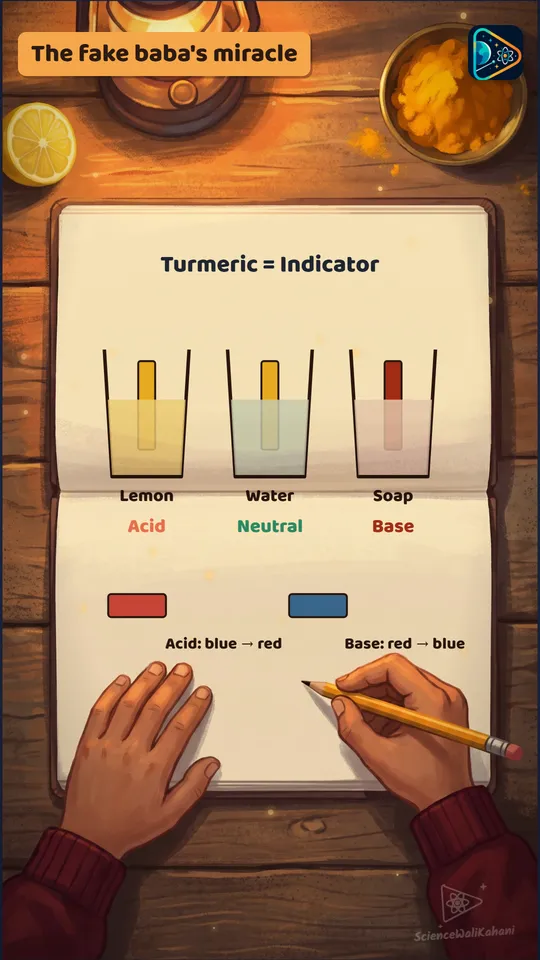
Litmus, the indicator you use in the school lab, does the same job:
- An acid turns blue litmus red.
- A base turns red litmus blue.
2. What makes something an acid or a base?
In water (the Arrhenius definition, Class 10):
- An acid releases H⁺ ions (strictly, H₃O⁺).
- A base releases OH⁻ ions.
Chuna is calcium hydroxide. In water it splits into ions:
Ca(OH)₂ → Ca²⁺ + 2OH⁻
one unit of chuna gives two OH⁻
That is why chuna water is such a strong base.
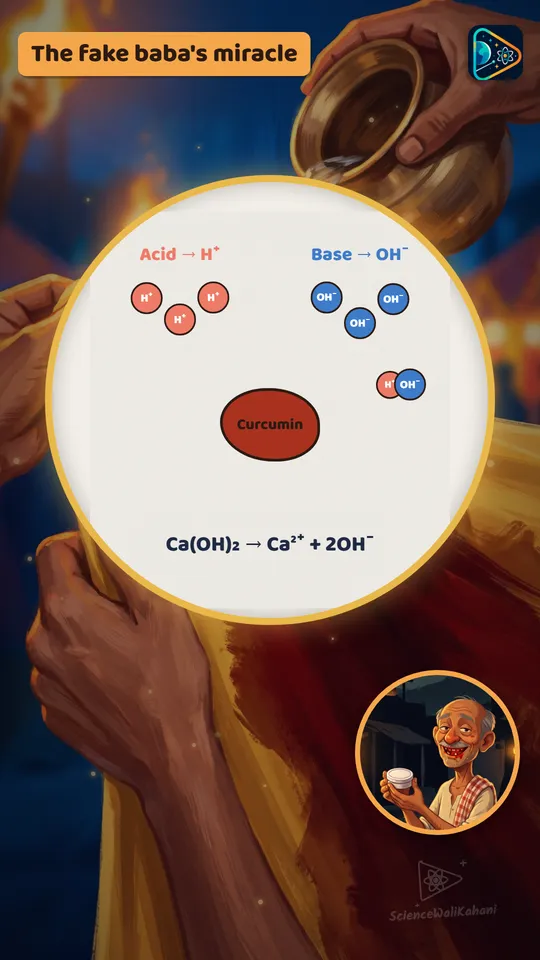
Why curcumin changes colour (Class 11–12)
Curcumin has –OH groups on its rings. In a base, OH⁻ pulls an H⁺ away from them (deprotonation). That changes the molecule's electron arrangement (its conjugated system), so it absorbs a different part of visible light, and we see red-brown instead of yellow. In acid or neutral water, curcumin keeps its H⁺ and stays yellow.
Most indicators, including phenolphthalein and methyl orange, work the same way: gaining or losing H⁺ changes the structure, and the structure decides the colour.
3. The pH scale: how strong is it?
pH runs from 0 to 14 at 25 °C. pH 7 is neutral (pure water), below 7 is acidic and above 7 is basic.
| Substance | Approximate pH |
|---|---|
| Lemon juice | 2 |
| Pure water | 7 |
| Soap solution | 9–10 |
| Chuna (lime) water | 12 |
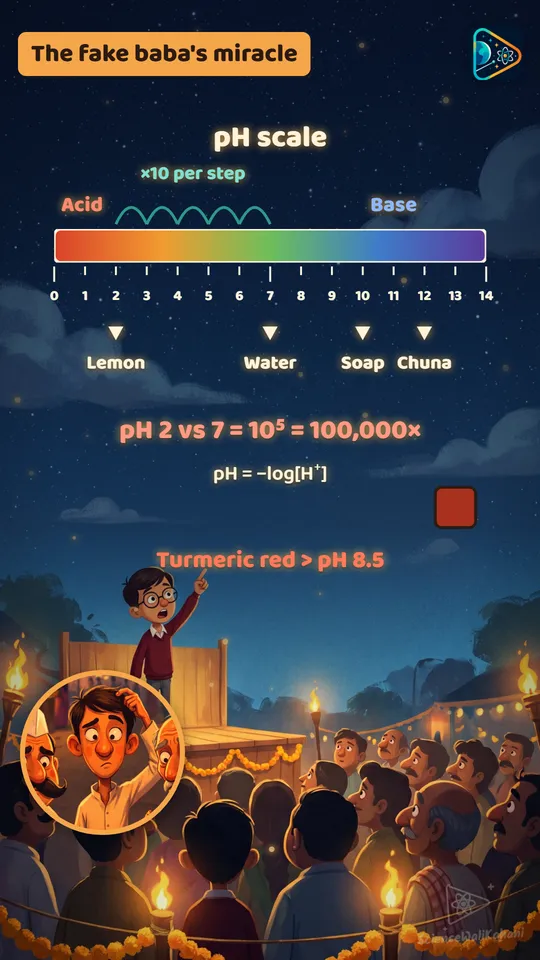
Turmeric turns red at about pH 8.5 and above. That is why soap and chuna both turn it red, but water doesn't.
Why lemon is 100,000 times more acidic than water
pH is a logarithmic scale:
pH = −log₁₀[H⁺]
each step of 1 pH is a 10× change in H⁺
So lemon juice (pH 2) against water (pH 7):
10⁽⁷⁻²⁾ = 10⁵ = 100,000 ×
five steps: 10 × 10 × 10 × 10 × 10
This one idea sits behind a large share of pH questions in board exams, NEET and JEE.
4. Neutralization: undoing the "miracle"
Golu poured lemon juice on the red cloth, and it turned yellow again. The H⁺ from the acid and the OH⁻ from the base joined to make water:
H⁺ + OH⁻ → H₂O
acid + base → salt + water
For example, HCl + NaOH → NaCl + H₂O.
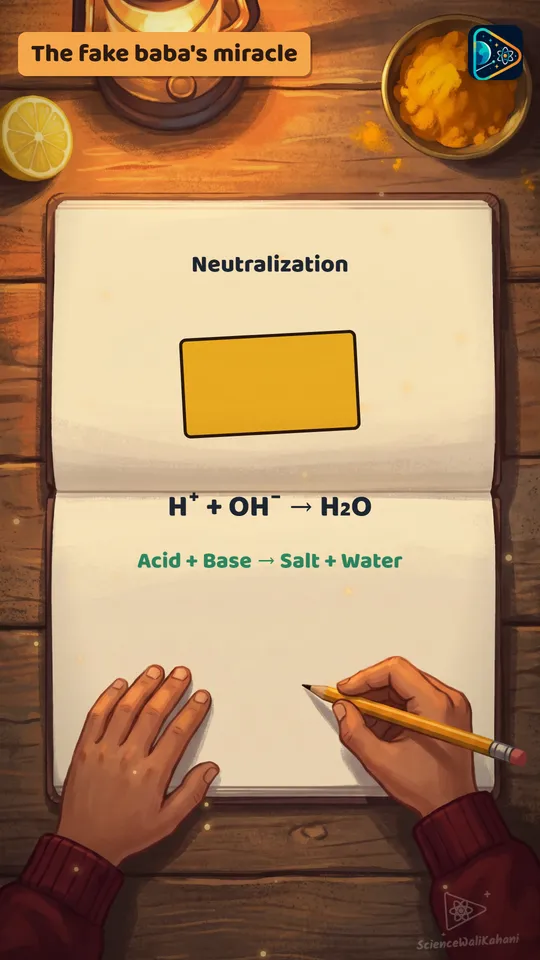
With the extra OH⁻ gone, the pH dropped below 8.5 and curcumin went back to yellow. The goddess hadn't calmed down; the chemistry had.
5. Practice questions
Try each one before you open the answer.
Class 10
A solution turns red litmus blue. Its pH is most likely: (a) 1 (b) 4 (c) 7 (d) 10
Show answer
**(d) 10.** Red litmus turning blue means a base, and bases have pH above 7.Class 10
A curry stain on a white shirt turns reddish-brown when washed with soap. Explain why.
Show answer
The stain contains turmeric (curcumin), a natural indicator. Soap is basic (pH about 9–10), and curcumin turns red-brown in a base. Rinsing with water and drying in the sun brings the yellow back.Class 10–11
Solution A has pH 3 and solution B has pH 6. How many times greater is the H⁺ concentration in A?
Show answer
**1,000 times.** 10^(6 − 3) = 10³.NEET / JEE
Find the pH of 0.01 M NaOH at 25 °C.
Show answer
NaOH is a strong base, so [OH⁻] = 0.01 = 10⁻² M. pOH = 2, so **pH = 14 − 2 = 12**.NEET / JEE
Chuna water is made with 0.005 M Ca(OH)₂. Assuming complete dissociation, find its pH at 25 °C.
Show answer
Each Ca(OH)₂ gives 2 OH⁻, so [OH⁻] = 2 × 0.005 = 0.01 M. pOH = 2, so **pH = 12**: the "about 12" from the story.NEET / JEE
What volume of 0.05 M NaOH exactly neutralizes 10 mL of 0.1 M HCl?
Show answer
HCl = 0.1 × 10 = 1 mmol, so you need 1 mmol of NaOH. Volume = 1 ÷ 0.05 = **20 mL**.6. The quiz from the video
An ant bite stings because the ant injects formic acid (HCOOH). What should you put on it?
Baking soda. It is a mild base (NaHCO₃), so it neutralizes the acid: HCOOH + NaHCO₃ → HCOONa + H₂O + CO₂
Vinegar is itself an acid (acetic acid), so it would not help.
Remember this
- Indicator: changes colour with acid or base. Turmeric turns red in a base (above about pH 8.5). Litmus turns red in acid and blue in base.
- Acid gives H⁺ in water; base gives OH⁻. Ca(OH)₂ → Ca²⁺ + 2OH⁻.
- pH = −log[H⁺]. Each pH step is 10×, so pH 2 against pH 7 is 100,000×.
- Neutralization: H⁺ + OH⁻ → H₂O; acid + base → salt + water.
Syllabus: NCERT Class 10 Science, Acids, Bases and Salts; NCERT Class 11 Chemistry, Equilibrium (ionic equilibrium and pH).