

Dhanteras afternoon in Indore. Marigold torans are up, the diyas are waiting, and the puja is at sunset. Dadi lifts her silver wedding thali out of the old green trunk. Sixty years, and it has never missed a puja. Today it is pitch black, and the jeweller's queue stretches down the street.
Bua rolls up her sleeves: "Leave it to me. Toothpaste and ash!" She scrubs hard, and the white cloth turns grey. Dadi's grandson Ayaan, 16 and in Class 11 science, grabs her wrist: "Stop, Bua! That grey is Dadi's silver! Get the foil."
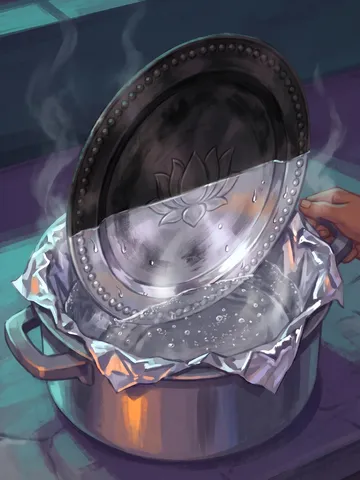
Dadi is not impressed. "Two-rupee foil, on my silver?" Ayaan lines a pot with kitchen foil, adds baking soda, and Bua pours in hot water. The thali is too wide for the pot, so only one edge dips in, onto the foil. Minutes later, that edge shines. The part above the water stays black.
1. The black is silver, not dirt
Silver reacts slowly with sulphur compounds in the air (mainly hydrogen sulphide, from cooking, eggs, rubber and pollution). The product is silver sulphide, Ag₂S, a black solid that forms a thin layer on the surface.
So the black layer is not dirt sitting on the silver. It is made of the silver itself, locked up with sulphur. That is why Ayaan stopped Bua: when you scrub the black away, you scrub away silver. Abrasive polishes do the same thing in smaller amounts. Compound Interest notes that they "also remove small amounts of silver".
2. More negative wins
Bua reads the numbers from Ayaan's book: silver +0.80 V, aluminium −1.66 V. "Minus? Foil's a loser!" That is the trap.
These numbers are standard electrode potentials (strictly, standard reduction potentials). Each one measures how strongly a metal's ion pulls electrons back to become metal. Read it the other way round and it tells you how easily the metal gives electrons away:
- The more negative the value, the more easily the metal gives away electrons.
- Aluminium (−1.66 V) gives electrons far more easily than silver (+0.80 V).
- In exams, "gives electrons easily" is called reducing power: aluminium is a much stronger reducing agent than silver.
E°(Ag⁺/Ag) = +0.80 V ; E°(Al³⁺/Al) = −1.66 V → aluminium gives, silver takes
more negative electrode potential = stronger reducing power
3. Where the foil touches, the electrons go in
The pot becomes a tiny electrochemical cell:
- At the foil (the anode), aluminium atoms give away electrons and become Al³⁺. The foil slowly goes dull: it is being used up.
- The electrons travel through the metal into the thali at the point where the foil touches it. The thali is one conductor, so they spread through all of it.
- On the black surface (the cathode), the silver in Ag₂S takes the electrons, becomes silver metal again, and lets go of the sulphur.
3 Ag₂S + 2 Al → 6 Ag + Al₂S₃
silver returns to the thali; the sulphur leaves with the aluminium
In water, the aluminium sulphide breaks down into aluminium hydroxide and a little hydrogen sulphide gas, which is why you may notice a faint rotten-egg smell.
The exact number, for the curious: the black layer's own couple is Ag₂S/Ag, about −0.7 V (Ag₂S + 2e⁻ → 2Ag + S²⁻, E° ≈ −0.69 V), not +0.80 V. Aluminium at −1.66 V is still far more negative, so the foil still wins easily. The video and the exam question use the NCERT table value for Ag⁺/Ag, +0.80 V.
4. Why the soda water, and why only the edge under it?
The electrons can flow through metal, but a cell also needs a path for ions. That is the job of the hot baking-soda water:
- It is the electrolyte. Dissolved sodium bicarbonate fills the water with ions, which carry charge between the foil and the thali and complete the circuit.
- It clears the foil. Aluminium is normally covered by a thin, protective oxide film. The mildly basic soda water removes it, so fresh aluminium can react.
- Heat speeds it up. Warm water makes the reaction go faster.
That is the clue Ayaan spotted. The electrons enter the whole thali through the contact point, but only the black silver that the soda water reaches has the ion path it needs. The part above the water stayed black. When Bua brought her wide atta parat, the thali could lie flat on the foil, fully under water, and all of it shone. The puja started on time: the silver stayed, and the foil paid.
5. Previous-year question, solved
NEET 2019 (re-exam)
The standard electrode potential (E°) values of Al³⁺/Al, Ag⁺/Ag, K⁺/K and Cr³⁺/Cr are −1.66 V, 0.80 V, −2.93 V and −0.74 V respectively. The correct decreasing order of reducing power of the metal is:
- Al > K > Ag > Cr
- Ag > Cr > Al > K
- K > Al > Cr > Ag
- K > Al > Ag > Cr
Show answer
K > Al > Cr > Ag.
- Reducing power = how easily the metal gives away electrons.
- The more negative E°, the stronger the reducing power, so order the values from most negative to most positive: K (−2.93) < Al (−1.66) < Cr (−0.74) < Ag (+0.80).
- Decreasing reducing power: K > Al > Cr > Ag.
The trap: Bua's mistake, "the bigger number is the stronger metal". It puts silver first, which is option 2 in the list above, the exact reverse of the answer.
(This is the 20 May 2019 re-exam paper, Aakash Code H1 Q45. Its option number differs between sources, so match the answer by its wording.)
6. Practice questions
Class 11
Arrange Mg (−2.36 V), Cu (+0.34 V), Zn (−0.76 V) and Ag (+0.80 V) in increasing order of reducing power.
Show answer
Ag < Cu < Zn < Mg. The more negative the E°, the stronger the reducing power, so the most positive (silver) is the weakest and the most negative (magnesium) the strongest.
JEE pattern
Find E°cell for 2 Al + 3 Ag⁺ → 2 Al³⁺ + 3 Ag, using E°(Al³⁺/Al) = −1.66 V and E°(Ag⁺/Ag) = +0.80 V.
Show answer
2.46 V. E°cell = E°(cathode) − E°(anode) = 0.80 − (−1.66) = 2.46 V. The common trap is to multiply by the coefficients 2 and 3: electrode potentials are intensive, so they are never multiplied by the stoichiometric numbers.
KCET pattern
In the foil-and-thali cell, which metal is the anode and which is the cathode? Where does oxidation happen?
Show answer
Aluminium foil is the anode (oxidation: Al → Al³⁺ + 3e⁻). The silver thali is the cathode (reduction: the silver in Ag₂S takes electrons and becomes Ag). Oxidation always happens at the anode.
NEET pattern
A copper wire is dipped in silver nitrate solution. Will silver coat the wire? E°(Cu²⁺/Cu) = +0.34 V, E°(Ag⁺/Ag) = +0.80 V.
Show answer
Yes. Copper's E° is more negative than silver's, so copper gives electrons to Ag⁺: Cu + 2 Ag⁺ → Cu²⁺ + 2 Ag. Silver deposits on the wire and the solution turns blue. Both values are positive here, which shows that "more negative" means lower on the scale, not "has a minus sign".
Class 11
The thali rested tilted, touching the foil at one edge, and only the edge under the water shone. Why not the part above the water, even though it was the same piece of metal?
Show answer
Electrons reach the whole thali through the metal, but the reaction also needs ions to complete the circuit, and only the soda water provides them. The black silver above the water had no electrolyte, so it could not take the electrons and stayed black.
Class 12
Why does the foil go dull and thin while the silver stays?
Show answer
The foil is the one being oxidised: aluminium atoms give away electrons and leave as Al³⁺ (which ends up as aluminium hydroxide). The silver is reduced: it gains electrons and returns to the metal. One metal pays with its atoms, the other gets its atoms back.
7. The quiz from the video
Which gives away electrons more easily: zinc, −0.76 V, or magnesium, −2.36 V?
Magnesium. −2.36 V is more negative than −0.76 V, so magnesium gives away electrons more easily: it has the stronger reducing power. Zinc's −0.76 only looks like the bigger number, which is exactly Bua's trap.
Remember this
- The black on silver is silver sulphide (Ag₂S): the silver is still there, locked with sulphur.
- Scrubbing throws silver away; foil in hot soda water turns it back into silver on the thali.
- More negative electrode potential = gives electrons more easily = stronger reducing power. Al (−1.66 V) beats Ag (+0.80 V).
- Foil = anode (oxidised, used up); thali = cathode (reduced, shines).
- Soda water is the electrolyte (the ion path) and clears the oxide film on the foil; only the part it reaches shines.
- E°cell = E°(cathode) − E°(anode); never multiply E° by the coefficients.
- Safety: an adult pours the hot water; baking soda only; not for plated or oxidised designs.
Another chemistry story: salt froze the kulfi: why salt beats sugar on ice.
Syllabus: NCERT Class 12 Chemistry, Chapter 2 Electrochemistry (standard electrode potential, electrochemical series, galvanic cells) and Class 11 Chemistry, Chapter 7 Redox Reactions (redox reactions and electrode processes). JEE Main and NEET unit "Redox reactions and electrochemistry"; 2nd PUC Chemistry for KCET.
Sources
- NCERT Class 12 Chemistry: Electrochemistry (standard electrode potentials, electrochemical series) and Class 11 Chemistry: Redox Reactions (redox reactions and electrode processes)
- Compound Interest, Removing tarnish from silver
- UC Davis LibreTexts, Cleaning silverware: an electrochemical reaction
- Aakash, NEET (UG) 2019 Code H1 (20-05-2019) solutions, Chemistry Q45 (https://www.aakash.ac.in/neet-answer-key-solution/NEET-2019-(Code-H1)_(20-05-2019)_Solutions.pdf)
- Smart Achievers, Electrochemistry NEET questions
Keep reading
 Lightning hit our car. Did the tyres save us? Why the electric field inside a conductor is zeroOn the Mohand ghat, lightning struck a wedding taxi and all four people inside walked out fine. The driver thanked the rubber tyres; he was wrong. Learn where the current really went, why charge sits on the outside of a conductor, why the field inside a closed metal shell is zero, and solve the NEET 2019 hollow-sphere question.
 Salt froze the kulfi: why salt makes ice colder and sugar can't (van 't Hoff factor)In a Lucknow kulfi shop three days before Diwali, the freezer died with 300 kulfis due by eight. Plain ice stuck at 0 °C, a kilo of sugar moved the thermometer half a degree, and a kilo of salt took it to −6 °C. Learn why freezing point depends on the number of particles, how ΔTf = i·Kf·m works, and solve the NEET 2025 question.
 Where did the blue go? Why coordination compounds are colouredMeera's blue copper sulphate turned white an hour before a Diwali chemistry contest. Learn crystal field splitting, why you see the complementary colour, the spectrochemical series, E = 1240/λ, and solve the NEET 2025 wavelength question.